
 Amethyst Bracelets
 Aquamarine Bracelets
 Citrine Bracelets
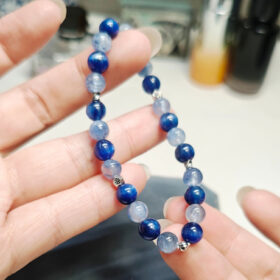 Kyanite Bracelets
 Moonstone Bracelets
 Rutilated Quartz Bracelets
 Rose Quartz Bracelets
 Silver Obsidian Bracelets
What Is Strawberry Quartz?
The grain inside the stone
Meaning, Care & Quality
A complete guide
Most people meet strawberry quartz by accident. They are browsing a tray of bracelets, their eye stops on soft pink beads flecked with fine red grain, and they ask whether this is rose quartz that has been dyed. It is not, and the difference matters to anyone who cares what they are buying. The strawberry quartz meaning comes from that grain: thousands of tiny mineral inclusions suspended inside clear quartz, each one a record of how the stone formed. Here is what the inclusions are, how the stone is classified, what crystal tradition associates with it, and how to wear it well.
What Is Strawberry Quartz?
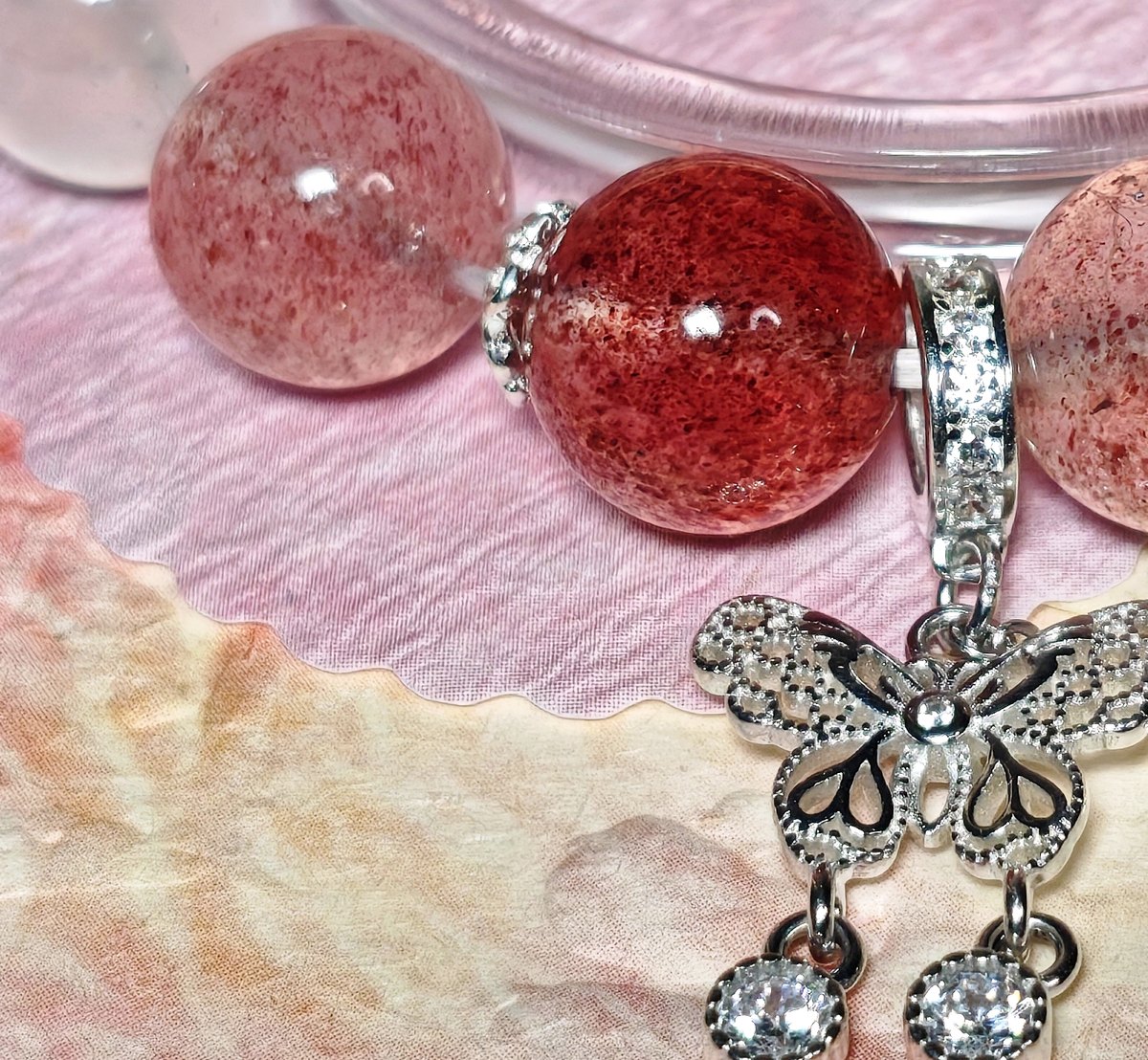
Strawberry quartz is quartz in which fine flakes of iron oxide — usually hematite or goethite — sit inside an otherwise transparent body. The quartz itself is colorless to very pale pink, so all the color you see comes from what is trapped within. That is why genuine strawberry quartz never looks flat or evenly tinted. It looks scattered, like fruit pulp suspended in syrup, and that is where the strawberry quartz meaning comes from in the first place.
Supply is inconsistent because the inclusions must be dense enough to be visible yet sparse enough to leave the body translucent. Too much iron and the stone turns opaque and brownish; too little and it reads as ordinary clear quartz.
Gemologically, strawberry quartz is not a separate mineral species. It is quartz with a specific inclusion pattern, which places it alongside rutilated and tourmalinated quartz in the same family. The Mindat entry for quartz lists the varieties, and the GIA’s quartz overview explains why inclusion patterns change a stone’s appearance so much without changing its composition. What it does tell you is that the speckles you are paying for are a genuine geological record, not a finish.
Strawberry Quartz Meaning in Crystal Tradition
In crystal tradition, the strawberry quartz meaning is read as warm, open-hearted presence, and the descriptions tend to be consistent across sources. It is described less as a high-energy stone and more as a gentle, steadying one — something people reach for when they want to feel settled in their own company.
Three threads run through most traditional descriptions:
- Heart-centered warmth. The pink-to-red palette places the strawberry quartz meaning in the same symbolic family as rose quartz, and many wearers describe it as encouraging openness toward other people — friendliness rather than romance.
- Grounding through iron. Because the colorant is iron oxide, writers often frame it as carrying a heavier quality than clear quartz, associated with staying present rather than drifting.
- Renewal. Its speckled, budding appearance is read as a symbol of growth, which is why the stone appears so often in gifts for graduations and fresh starts.
These are cultural readings, passed down through lapidary and metaphysical writing rather than geology. What does matter practically is durability: quartz sits at hardness 7 on the Mohs scale, which makes it a sensible choice for a bracelet worn daily.
Strawberry Quartz vs Rose Quartz
Rose quartz and strawberry quartz are regularly mixed up, and the difference between them is more mechanical than mystical.
| Feature | Strawberry Quartz | Rose Quartz |
| Appearance | Transparent body with visible red or pink speckles | Milky to translucent pink, even throughout |
| Source of color | Iron oxide inclusions inside the quartz | Trace elements within the crystal lattice |
| Transparency | Usually clear enough to read through | Typically cloudy, rarely fully transparent |
| Price | Higher, since clean speckled material is scarce | Lower, available in many grades |
| Symbolic reading | Warmth, renewal, staying present | Love, softness, self-compassion |
Visually, the giveaway is transparency. Hold a strand to a window: if you can see the shape of the far-side beads and the pink sits in discrete clouds rather than an even wash, you are looking at strawberry quartz. If the stone is uniformly hazy and pink all the way through, it is most likely rose quartz — or a dyed material standing in for one of them.
Rose quartz remains the easier entry point if you simply want a pink bead. Strawberry quartz is the choice when the speckled pattern itself is the point. Both appear in our guide to choosing a crystal for your needs, which sorts stones by the quality each is traditionally associated with.
Crystal vs Gemstone: How the Stone Is Classified
Both words apply, and neither is precise. Quartz is a mineral with a crystalline structure, so the raw material is a crystal in the technical sense; nothing about that structure guarantees the strawberry quartz meaning, which is a matter of tradition rather than crystallography. A gemstone is a lapidary term for a cut stone valued for appearance, so once the rough is shaped into rounds and strung, the same material is a gemstone as well.
For shopping, the question of crystal versus gemstone is mostly noise. Either label is unregulated and says nothing about how the stone was processed. What the stone is called does not change its color or its grain.
Layering It with Other Stones
Because the stone is transparent and mid-tone, it works as a bridge in a stack. Place it between a darker strand and a paler one and the eye reads a gradient rather than three separate bracelets.
Three combinations that hold up in everyday wear: with black obsidian for contrast, where the speckle gives the dark beads something to reflect; with moonstone, where both stones share a milky, shifting quality; and with blue rutilated quartz, where the needle inclusions on one strand echo the grain on the other. The last pairing is the most deliberate, and the one most people notice.
Strawberry Quartz Properties and Symbolism
Beyond the broad themes, strawberry quartz properties are described in crystal writing with a fairly consistent vocabulary. Many wearers describe it as a steadying stone. The associations most often attached to it:
- Emotional balance in everyday terms — traditionally associated with even moods and patience with oneself.
- Confidence in social settings — often framed as a stone for people who find small talk draining.
- Optimism and forward motion — the renewal reading applied to projects rather than feelings.
- Connection between heart and mind — a phrase that appears in nearly every traditional description of pink quartz varieties.
Crystal meanings are cultural and traditional beliefs, not medical advice. Nothing here is a substitute for professional care.
If the renewal theme appeals to you, pair the stone with kyanite for clarity of thought or with clear quartz for focus. Pink speckle next to pale blue also reads well on the wrist.
How to Tell If Strawberry Quartz Is Real
Because the stone commands a premium, substitutes are common. Most of them are easy to spot once you know what to look for.
Check the inclusions, not the color. Genuine inclusions are irregular. They sit at different depths, vary in density from bead to bead, and sometimes cluster near the surface in a way that looks almost like a flaw. If every bead has an identical speckle pattern, or the pink runs in a perfect gradient, suspect a synthetic or a dyed clear quartz.
Compare beads on the same strand. Natural material is never perfectly matched. Real strawberry quartz shows beads that are lighter, darker, more and less densely speckled. Perfect uniformity across a full bracelet is a machine-made signal.
Look inside the drill hole. Dye pools where the drilling is. If the interior of the hole is noticeably deeper in color than the bead surface, the color was applied rather than formed.
The most common deception is not outright fake quartz but a substitution of name — pink crackle quartz sold under a strawberry label, or a naturally included but heavily dyed strand presented as having no color added. Neither is dangerous; both are worth walking away from if the seller will not name what they are selling.
What Makes a Good Strawberry Quartz Bracelet
Quality is judged on four things, and they trade off against each other.
- Transparency. The clearer the body, the more the inclusions stand out. Heavily clouded material loses the effect that makes the stone worth buying.
- Inclusion definition. Visible, distributed grain — dense enough to read from arm’s length, not so dense that the stone goes opaque.
- Color consistency. Beads can vary, but the strand should sit in one temperature. Mixing cool lavender-pink with warm brick-red looks assembled rather than chosen.
- Cut and polish. Round beads should be genuinely round, with a smooth surface and no pitting at the hole. Polish is what makes inclusions look suspended rather than dusty.
Bead size changes how the piece reads. Eight millimeters feels delicate on a small wrist; ten to twelve gives the stone enough surface to show its grain properly. Our crystal bracelet size guide covers wrist measurement and the fit difference between snug and relaxed strands.
Strawberry Quartz in Fine Jewelry
Strawberry quartz is forgiving in jewelry design, which is why it works in both minimal and ornate settings. Because the body is transparent and the inclusions supply all the visual interest, it needs very little help — a plain silver spacer is often enough.
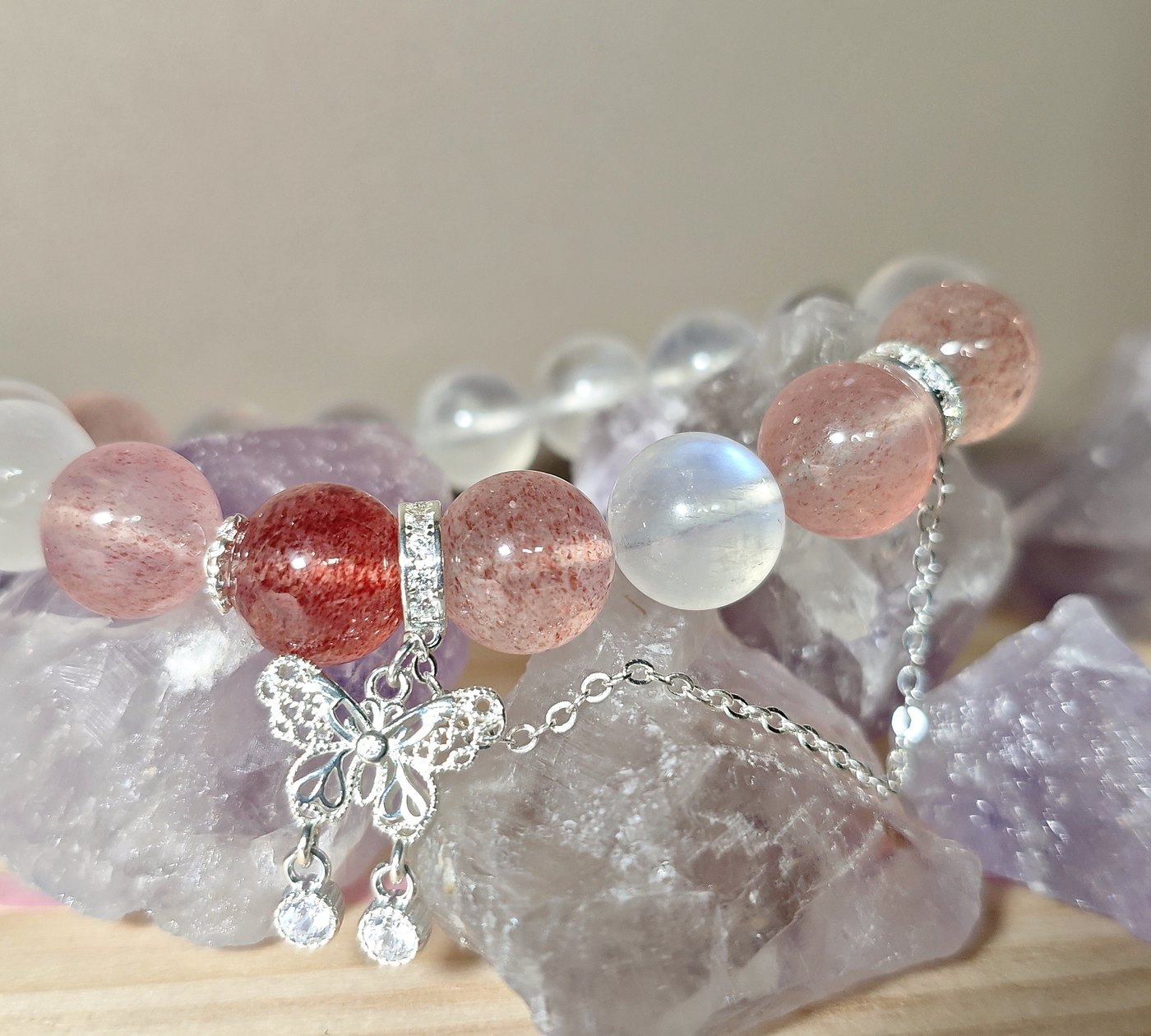
The restrained approach pairs the beads with 925 sterling silver and one focal element, keeping everything else off the wrist. That is the logic behind the Eternal Metamorphosis Crystal Bracelet, where speckled strawberry quartz and clear quartz sit beside a single butterfly charm occupying about a ninth of the strand, so the stone stays the subject.
A softer reading uses milky rather than fully clear neighbors, lowering the contrast until the bracelet reads almost like blush fabric. The Ice Strawberry Quartz Tulip Bracelet takes that route with pale quartz and a tulip-shaped silver accent.
Either way, the ratio matters more than the metal. When strawberry quartz is more than about two-thirds of the strand, the piece reads as a stone bracelet. Below that, it reads as a bracelet that happens to contain strawberry quartz, which is a different object entirely.
How to Wear Strawberry Quartz
Crystal tradition often assigns the left wrist to qualities you want to bring inward and the right to qualities projected outward. Writers describe its symbolism both ways, so keep it as preference rather than rule. Most people wear it on the non-dominant hand simply because it gets knocked about less, and with a stone this translucent, scratches are the wear you are most likely to notice.
The transparency means it stacks well without looking heavy. Two rules keep a stack clean: keep bead sizes close, and limit the palette to two colors. Strawberry quartz with aquamarine and kyanite gives a cool contrast; with golden rutilated quartz it warms toward sunset.
Quartz is hard but brittle, so remove the bracelet for the gym, for swimming, and for any task involving a grip on metal or stone. Chlorinated water and long sun exposure are also worth avoiding — not because the quartz dissolves, but because repeated heat and chemicals dull the polish, and in heat-altered material can shift the color.
Cleaning and Care
The stone is easy to keep looking its best because the inclusions are mineral rather than organic and the body is chemically stable.
- Weekly: wipe with a dry microfiber cloth to remove skin oils. That alone restores most of the gloss.
- Monthly: wash in lukewarm water with a drop of mild soap, scrub gently around the holes with a soft brush, rinse and pat dry.
- Avoid: ultrasonic cleaners if the piece has glued settings, and ammonia-based cleaners, which attack silver fittings first.
- Storage: keep it in a soft pouch rather than loose in a drawer, so it does not scratch softer stones.
If you follow a cleansing routine, the practical version is simply rinse, dry, and an hour in indirect daylight. Our cleansing and recharging guide covers the fuller version, including what not to do with silver hardware. A lined jewelry case solves storage for anyone wearing several strands.
Gifting Strawberry Quartz
The strawberry quartz meaning gives the stone an obvious place in gifts for transitions: a new job, a move, a graduation, a first apartment. It is also a low-risk gift for someone whose taste you do not know well, because the stone is visually soft and suits both gold and silver.
Two practical notes. Size first — a bracelet is a fit-dependent gift, and a strand two centimeters too loose will slide over the hand. Light second: the pink reads differently under warm indoor light than in daylight, so ask for a photo taken in natural light if that is all you have to go on.
Frequently Asked Questions
Is strawberry quartz the same as rose quartz?
No. Both are quartz, but rose quartz is colored by trace elements inside the crystal lattice and is typically cloudy and evenly pink. Strawberry quartz is transparent quartz filled with visible iron oxide inclusions, which is what produces the speckled look and the higher price.
Can strawberry quartz be dyed or synthetic?
Yes, and both are common. Crackled clear quartz with pink dye forced into the fractures, and reconstituted material made from crushed quartz, both circulate widely. Look for color pooling at the drill hole and an identical speckle pattern across every bead — natural strands vary.
Does strawberry quartz fade in sunlight?
Natural material is generally stable in daylight because its color comes from mineral inclusions rather than a light-sensitive dye. Artificially colored material can fade. Store any colored quartz away from direct sun and it will not be an issue.
What does strawberry quartz look like when worn?
On the wrist it reads as soft, semi-transparent blush with fine red grain that catches the light. Up close the inclusions are distinct; at arm’s length it usually looks like a warm pink strand, which is why it sits comfortably next to neutral and pastel wardrobes alike.
Is strawberry quartz good for everyday wear?
It is, with care. At hardness 7 it resists scratching from daily contact but can chip if struck against a hard edge. Remove it for the gym, for swimming, and for any task where the wrist takes impact.
Which bead size should I choose?
Eight millimeters reads delicate and suits wrists under about 16 centimeters. Ten to twelve suits most adult wrists and shows the inclusion pattern more clearly. If the strand is not adjustable, measure your wrist first and add about a centimeter of ease.
Does strawberry quartz need to be cleansed?
Not physically. Cleansing is a tradition rather than a maintenance requirement, and the stone’s appearance and durability do not depend on it. Regular wiping to remove skin oils is the only step that actually affects how the bracelet looks and wears.
The Short Version
The strawberry quartz meaning comes down to one idea: visible growth. The stone is quartz carrying the record of its own formation in the form of iron oxide grain, and crystal tradition reads that pattern as warmth, renewal and presence. Buy it for the inclusions, check the strand for uniformity, wear it on the arm that does less work, and it will keep its polish for years.
Browse the full crystal bracelet collection to see how the stone sits next to clear quartz, moonstone and rutilated varieties in a real stack.