
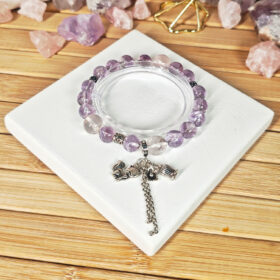
 Amethyst Bracelets
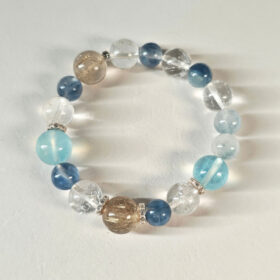 Aquamarine Bracelets
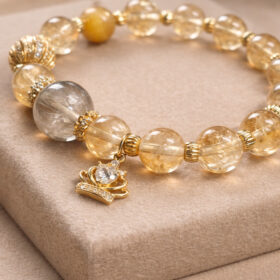 Citrine Bracelets
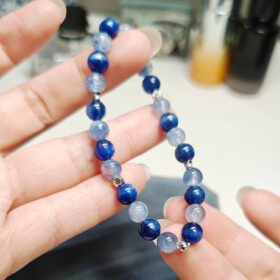 Kyanite Bracelets
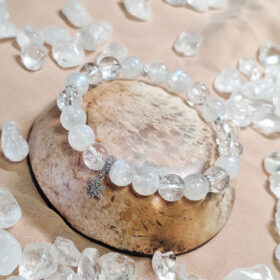 Moonstone Bracelets
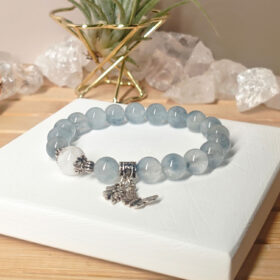 Rutilated Quartz Bracelets
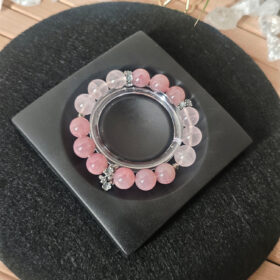 Rose Quartz Bracelets
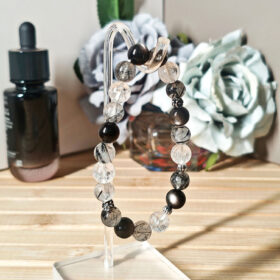 Silver Obsidian Bracelets
Find Your Size
One Measurement, Right Fit
Explore Crystal Bracelets
More Stones, More Sizes
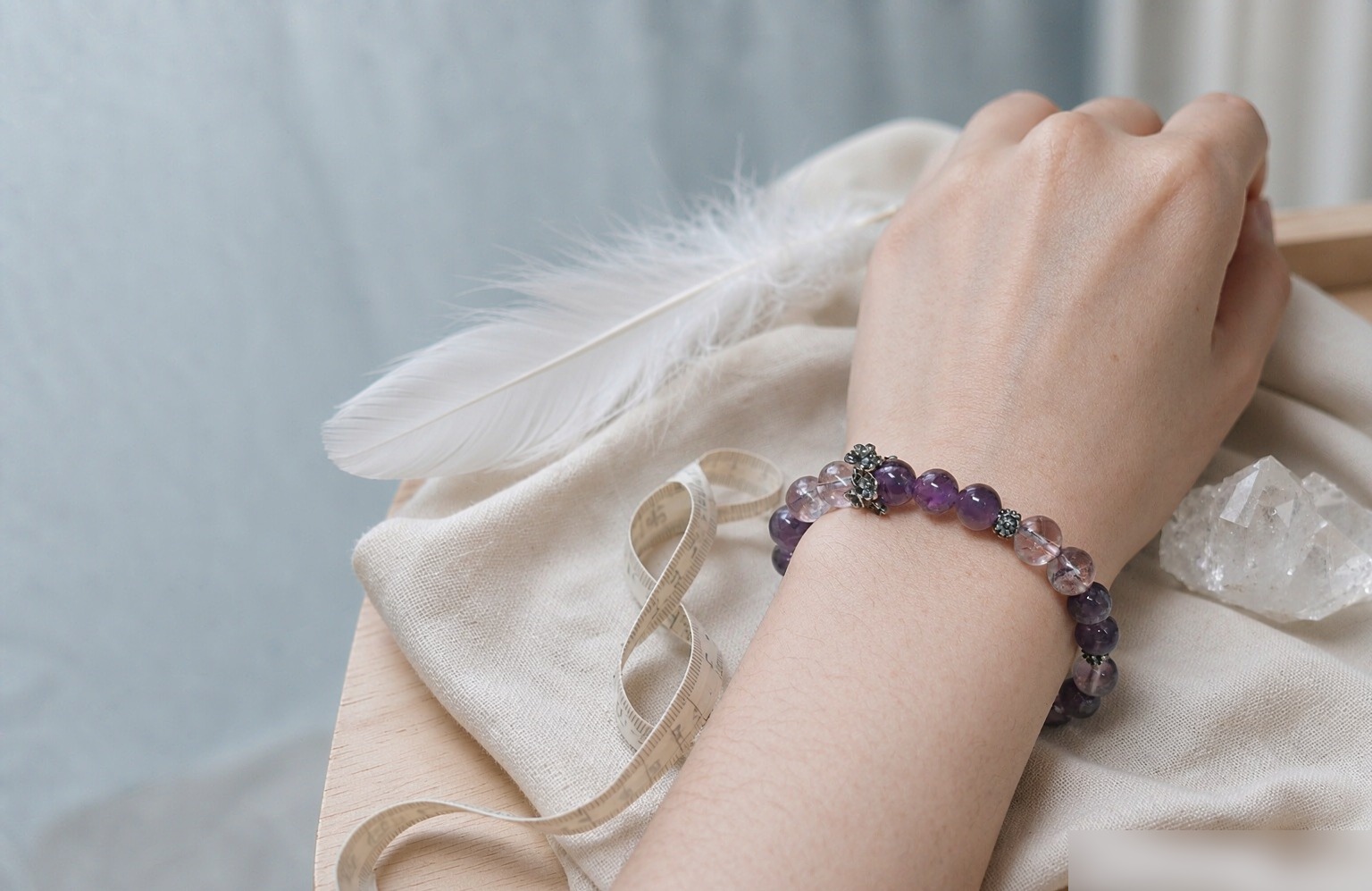
Getting the crystal bracelet size wrong is the most common reason a beautiful bracelet ends up in a drawer. Too tight and it pinches, catches on sleeves and keeps the elastic under tension. Too loose and it slides past the wrist bone, spins so the focal bead is never where you want it, and takes more knocks against doorframes and desk edges.
This guide fixes that. You will learn how to measure your wrist properly, how to turn that number into a bracelet length, how bead diameter quietly changes the fit, and what to do when you are buying for someone else.
Why Crystal Bracelet Size Matters More Than You Would Expect
A bracelet is the one piece of jewellery that has to clear a joint. Your hand is wider than your wrist, so a piece that looks perfect lying flat still has to stretch over the widest part of your palm every time you put it on. That, not the wrist measurement, is the real constraint.
The right crystal bracelet size also decides how the piece behaves all day. A bracelet sitting close to the wrist bone stays put, so a feature bead stays facing outward. A looser piece rotates, which is fine for a casual look but loses any intentional placement. And elastic that is overstretched every time you put the bracelet on wears out faster — the failure point is almost always the knot.
How to Measure Your Wrist for a Crystal Bracelet
You need one of three things: a soft measuring tape, a strip of paper, or a piece of string and a ruler.
- Measure the wrist bone, not the forearm. Place the tape about one finger’s width below the wrist bone — the spot where a bracelet naturally rests. Measuring higher up the arm gives you a number that is too large.
- Keep the tape flat and snug. It should lie flat against the skin with no gap, but it should not compress the skin. If you are using paper or string, wrap it, mark where the ends meet, then lay it flat against a ruler.
- Take the number twice. Write down the measurement in both inches and centimetres. If the two attempts differ by more than 1/8 in (3 mm), measure a third time and use the middle value.
- Measure at the end of the day. Wrists swell slightly with heat and activity. An evening measurement is the realistic worst case, and it is better to size for that than for a cold morning.
- Note your hand width as well. Press your hand flat, thumb tucked toward the palm, and measure around the widest part. If this number is more than about 1.5 in (4 cm) larger than your wrist, you need a bracelet with a clasp or a generous elastic allowance rather than a very snug fit.
That wrist number is your baseline. Everything below builds on it.
Crystal Bracelet Size Chart
The chart converts a wrist measurement into a finished bracelet inner circumference. The three fit columns exist because personal preference genuinely varies, and because bead size shifts the recommendation.
| Wrist measurement | Snug fit | Comfort fit | Loose fit |
|---|---|---|---|
| 5.5 in / 14.0 cm | 6.0 in / 15.2 cm | 6.25 in / 15.9 cm | 6.5 in / 16.5 cm |
| 6.0 in / 15.2 cm | 6.5 in / 16.5 cm | 6.75 in / 17.1 cm | 7.0 in / 17.8 cm |
| 6.5 in / 16.5 cm | 7.0 in / 17.8 cm | 7.25 in / 18.4 cm | 7.5 in / 19.1 cm |
| 7.0 in / 17.8 cm | 7.5 in / 19.1 cm | 7.75 in / 19.7 cm | 8.0 in / 20.3 cm |
| 7.5 in / 19.1 cm | 8.0 in / 20.3 cm | 8.25 in / 21.0 cm | 8.5 in / 21.6 cm |
| 8.0 in / 20.3 cm | 8.5 in / 21.6 cm | 8.75 in / 22.2 cm | 9.0 in / 22.9 cm |
Read this as a starting point rather than a rule. If you plan to wear one bracelet on its own, the comfort column is the safest choice for most people. If you intend to stack two or three, size each one a touch looser so the group does not bind when your wrist flexes.
One practical caution: manufacturers measure bracelets differently. Some quote the inner circumference, some quote the length of the strand laid flat. When a product page gives a number, check which one it is, because the difference is usually 0.25–0.5 in (6–13 mm) — enough to move you a full fit category.
Snug, Comfort, or Loose: Choosing Your Fit
Snug (wrist + 0.25 to 0.5 in / 0.6 to 1.3 cm). The bracelet stays exactly where you put it and rarely rotates. It is the cleanest look under a shirt cuff. The trade-off is that it will feel restrictive when your hands are warm, and it puts steady tension on the elastic.
Comfort (wrist + 0.5 to 0.75 in / 1.3 to 1.9 cm). The default for most wearers and the one we recommend if you are unsure. It slides about half an inch along the forearm, clears the wrist bone without effort, and looks intentionally placed rather than accidentally tight.
Loose (wrist + 0.75 to 1.25 in / 1.9 to 3.2 cm). Relaxed and easy, and the right call for larger beads or for a piece you want to slide off over the hand without stretching the cord. Expect it to rotate and to sit closer to the hand than the wrist bone.
A quick field test: you should be able to slide one fingertip — not two, not zero — between the bracelet and your skin. That single fingertip is the comfort fit in physical form.
How Bead Diameter Changes the Way a Bracelet Fits
This is the detail most sizing guides skip, and it is the reason two bracelets with identical inner circumferences can feel completely different.
Beads have thickness. The inner circumference is measured through the drill holes, which is the circle that touches your skin, but the outer surface of the beads sits further out. The larger the bead, the thicker that band of material, and the more the strand resists bending tightly around a small wrist. Big beads also add visible bulk, so a snug fit that looks fine at 6 mm can look strained at 12 mm.
A working rule for ease, on top of your wrist measurement:
| Bead diameter | Extra ease to add | What it looks like |
|---|---|---|
| 4–6 mm | +0.25 to 0.5 in (0.6–1.3 cm) | Sits close, drapes softly, good for stacking |
| 8 mm | +0.5 to 0.75 in (1.3–1.9 cm) | The everyday standard; balanced look |
| 10 mm | +0.75 to 1.0 in (1.9–2.5 cm) | Statement piece; needs room to sit properly |
| 12 mm and above | +1.0 to 1.25 in (2.5–3.2 cm) | Bold; often better on a clasp than on elastic |
Mixed-size designs need the larger number. A strand that alternates 8 mm beads with 10 mm accents should be sized as though it were a 10 mm piece, because the largest beads set the minimum bend radius. That is exactly how our blue rutilated quartz bracelet is built — 8–8.8 mm blue rutilated quartz with 10 mm white phantom accents — so it is sized on the generous side.
Elastic Cord vs Clasp: What It Means for Sizing
Nearly all beaded gemstone bracelets use elastic, which is forgiving: it stretches over the hand and relaxes back. That forgiveness has a limit, and it is why elastic pieces need more ease than a clasp version of the same bead size — every time you pull a snug elastic bracelet over your hand, you ask the cord to stretch past its comfortable range.
A clasp removes that step. You open it, place the bracelet on the wrist, close it. Because it never has to clear the hand, a clasp bracelet can sit about 0.25 in (6 mm) closer to the wrist measurement than the elastic equivalent. The trade-off is the extender chain, whose dangling end can catch on knitwear.
If you are between sizes, elastic should go up and a clasp can stay put.
Which Wrist Should You Wear Your Crystal Bracelet On?
Honestly, it is a matter of habit. Most people wear a bracelet on the non-dominant hand because it interferes less with writing, typing and cooking. In crystal tradition the receiving-versus-giving hand distinction is a common talking point, but nothing requires it. Choose the wrist you will forget you are wearing. If you wear a watch, put the bracelet on the other side or two finger-widths above it, so the two do not grind together.
Stacking Crystal Bracelets Without Overcrowding Your Wrist
Stacking is where sizing mistakes compound: three bracelets that each fit alone can feel tight as a group, because they take up length along the forearm and cannot overlap.
Three rules keep a stack comfortable:
- Size each piece about 1/8 in (3 mm) looser than you would wear it alone.
- Keep bead diameters within 2 mm of each other. Big differences create gaps and make the stack rub.
- Cap it at three. Beyond that the group pushes toward the elbow and the outer pieces take the impact.
If you mix stones, pick one piece as the anchor and build around it. Our aquamarine and kyanite bracelet works as a cool-toned anchor; the Clarity crystal bracelet is a quieter companion that does not compete for attention.
Choosing a Crystal Bracelet Size as a Gift
Gifting is the hardest sizing problem, because you cannot ask and cannot measure. Three tactics reduce the risk:
- Measure a bracelet they already own. Lay it flat, measure end to end including the clasp. That is their proven comfortable length, far more reliable than guessing from their build.
- Choose the comfort-to-loose end. A slightly loose bracelet is wearable; a slightly tight one is not.
- Prefer elastic. Elastic forgives a quarter-inch of error in either direction, which is about the margin you are likely to be off by.
Add storage and the gift becomes a set. A dedicated jewellery case for bracelets keeps the elastic relaxed and the stones separated — beads knocking together in a drawer is a common cause of surface wear.
What Different Stones Are Traditionally Associated With
Crystal meanings are cultural and traditional beliefs, not medical advice. Nothing on this page should be read as a medical claim.
Once the crystal bracelet size question is settled, the stone itself is the next decision. In crystal tradition, different materials carry different associations, and many wearers describe choosing a stone to match an intention rather than an outfit.
Rutilated quartz is traditionally associated with momentum and forward movement; the needle-like inclusions give it a distinctive look and it is often chosen by people starting something new. You can see how the golden and blue varieties differ in our rutilated quartz bracelets collection. The golden rutilated quartz and citrine bracelet is the classic combination, and our blue rutilated quartz bracelet pairs 8–8.8 mm blue rutilated quartz with 10 mm white phantom quartz for a cooler version of the same idea.
Aquamarine and kyanite are associated in crystal tradition with clear communication and steady expression. Our guide to aquamarine bracelets covers the stone in more depth.
Amethyst carries a long tradition of association with clarity of thought. If you are weighing stones against each other, What Crystals Are Best for You walks through the selection logic step by step.
Keeping the Fit: Elastic, Care and Cleansing
Elastic is a consumable part. Under normal wear it lasts one to three years before it feels slack or frays near the knot; heat, water, perfume and sunscreen all shorten that. Roll the bracelet off over the hand rather than stretching it open, take it off before swimming or showering, and store it flat.
Stone hardness varies, and a bracelet worn daily will pick up fine scratches. Quartz-family stones sit around 7 on the Mohs scale and hold up well; softer materials need more care. For mineral hardness and identification reference, mindat.org is the standard open database, and the Gemological Institute of America publishes accessible gem care material.
For the traditional side of maintenance, see How to Cleanse and Recharge a Crystal Bracelet in Detail. Cleansing method matters for fit: salt water and prolonged sun are hard on elastic and on some stones, so a dry method is safer for a strung piece.
Frequently Asked Questions About Crystal Bracelet Size
What crystal bracelet size should I buy if my wrist is 6.5 inches?
Start with 7.25 in (18.4 cm) inner circumference for a comfort fit. Choose 7.0 in if you like it snug and stay put, or 7.5 in if you want it to move freely or plan to stack.
How tight should a crystal bracelet be?
Tight enough that it does not slide past the wrist bone, loose enough that you can slide one fingertip underneath. If you cannot get a fingertip in, it is too small and the elastic is under constant tension.
Does bead size change what crystal bracelet size I need?
Yes. Larger beads sit further off the skin and bend less tightly, so they need more ease. Add roughly 0.25 in (6 mm) of extra length for every 2 mm increase in bead diameter.
Should I size up if I wear a bracelet every day?
Slightly. Daily wear means more stretching on and off, so the comfort end of the range is better than the snug end. A bracelet you fight with every morning is one you will stop wearing.
How do I pick a crystal bracelet size as a gift without measuring?
Measure a bracelet they already wear and match it. If that is not possible, choose the larger of the two sizes you are considering — a loose bracelet can always be worn, a tight one cannot.
Can an elastic crystal bracelet be resized?
Usually yes. Re-stringing is straightforward and is also the moment to replace the elastic, which is worth doing at the same time. A jeweller can do it, or you can do it at home with beading elastic and a needle.
Is a clasp bracelet sized differently from elastic?
Yes. A clasp never has to clear your hand, so it can be around 0.25 in (6 mm) shorter than the elastic equivalent for the same wrist.