
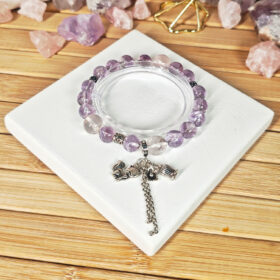
 Amethyst Bracelets
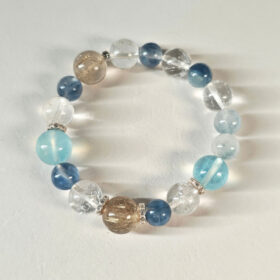 Aquamarine Bracelets
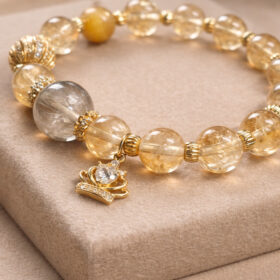 Citrine Bracelets
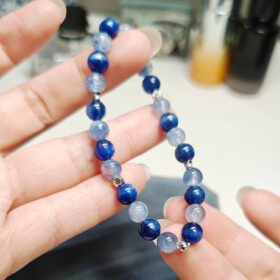 Kyanite Bracelets
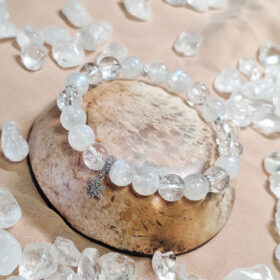 Moonstone Bracelets
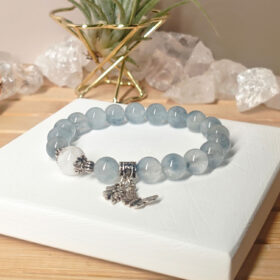 Rutilated Quartz Bracelets
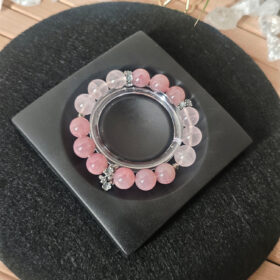 Rose Quartz Bracelets
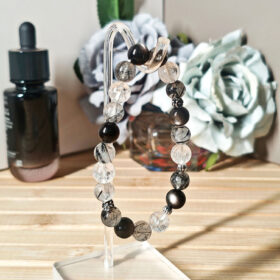 Silver Obsidian Bracelets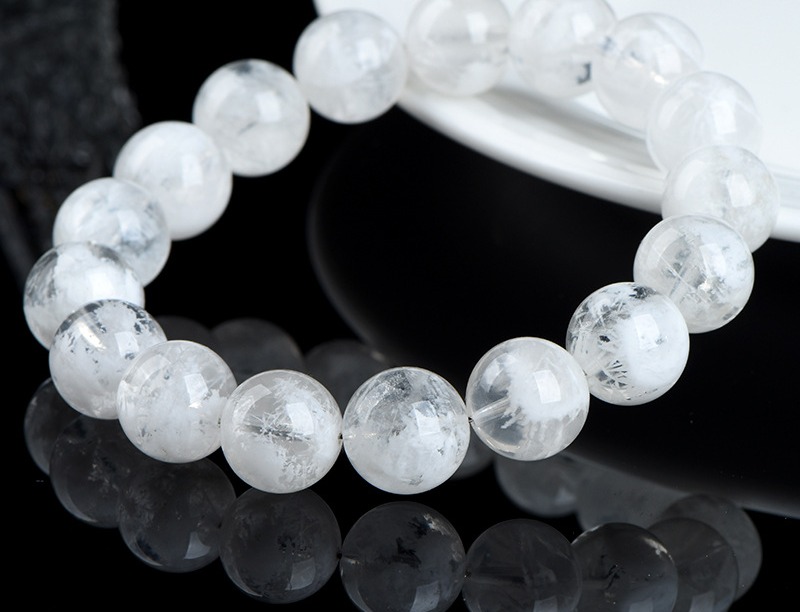
Inside the Stone
Ghost Layers, Explained
Explore Included Quartz
Phantom, Rutile & More
Hold a piece of phantom quartz up to a window and you may see something that looks impossible: a smaller crystal, perfectly outlined, floating inside a larger one. It is not a trick of the light and it is not a second stone trapped inside. It is the earlier shape of the very same crystal, preserved as a thin film of dust or mineral, then sealed over as growth continued. Few stones carry their own history so literally.
This guide explains the phantom quartz meaning in crystal tradition, how these ghost crystals actually form underground, the main types you will meet when shopping, how they differ from rutilated quartz, and how to spot a genuine phantom before you buy. Whether you collect specimens or simply want to understand the beads on your wrist, the inner outline is worth learning to read.
What Is Phantom Quartz?
Phantom quartz is a variety of quartz containing a visible internal outline — a “phantom” — that marks an earlier stage of the crystal’s own growth. The outline traces the shape of the crystal at some point in the past, usually including the pointed termination and the prism faces. Because quartz grows in straight, geometric faces, the ghost repeats the hexagonal silhouette of the whole crystal in miniature.
“Phantom” is a trade and collector term, not a separate mineral species. Chemically this is still silicon dioxide, part of the included quartz family alongside garden quartz and rutilated quartz. What sets it apart is geometry: the inclusions form a coherent, sharply defined outline rather than scattering at random — and that structure is where the phantom quartz meaning begins.
You will find phantoms in clear rock crystal, smoky quartz, amethyst and citrine. The host colour changes the look, but the mechanism stays the same.
For the formal mineral data on the host species, the mindat.org quartz mineral page is the standard reference collectors use; the GIA gem education library is a good companion for how inclusions are described in the gem trade.
How Phantom Quartz Forms
Growth, pause, coating, growth again
Quartz grows from hot, silica-rich fluids moving through cavities in rock. As the fluid cools or its chemistry shifts, silicon dioxide precipitates onto the crystal, layer by layer, face by face. A phantom appears when that process is interrupted:
- Growth stops. The fluid changes, the cavity drains, or conditions stop favouring deposition.
- A coating settles. Fine clay, chlorite, iron oxide, tiny bubbles or simple dust lands on the exposed faces.
- Growth resumes. Fresh quartz covers the coating, burying the earlier outline inside.
- The cycle may repeat. Several concentric phantoms then stack up like tree rings.
Because the coating is extremely thin, light still passes through it. That is why the ghost looks soft and translucent rather than opaque.
Why the outline stays visible
The coating changes how light travels at that boundary — scattering it slightly, adding colour, or trapping minute bubbles. Your eye reads the refractive break between the coated surface and the clear quartz as a shape. It is also why some phantoms only appear from certain angles: rotate a stone under a light and a faint ghost can flash into view, then vanish.
The Main Types of Phantom Quartz
The type of phantom is named for the mineral that made the coating. Each one looks distinctly different in a finished bead.
| Phantom type | Coating mineral | Typical colour | What it looks like |
|---|---|---|---|
| White phantom | Kaolinite, clay, fluid film | Milky white | Most common in bead form; soft, cloud-like outlines |
| Chlorite phantom | Chlorite | Green to grey-green | Often from alpine-type deposits; earthy look |
| Hematite phantom | Hematite / iron oxide | Rust red, brown | Strong contrast against clear quartz |
| Smoky phantom | Colour zoning from natural irradiation | Grey to near-black | Ghost appears as a dark band |
| Amethyst phantom | Iron colour centres | Purple | Purple ghost inside clear quartz |
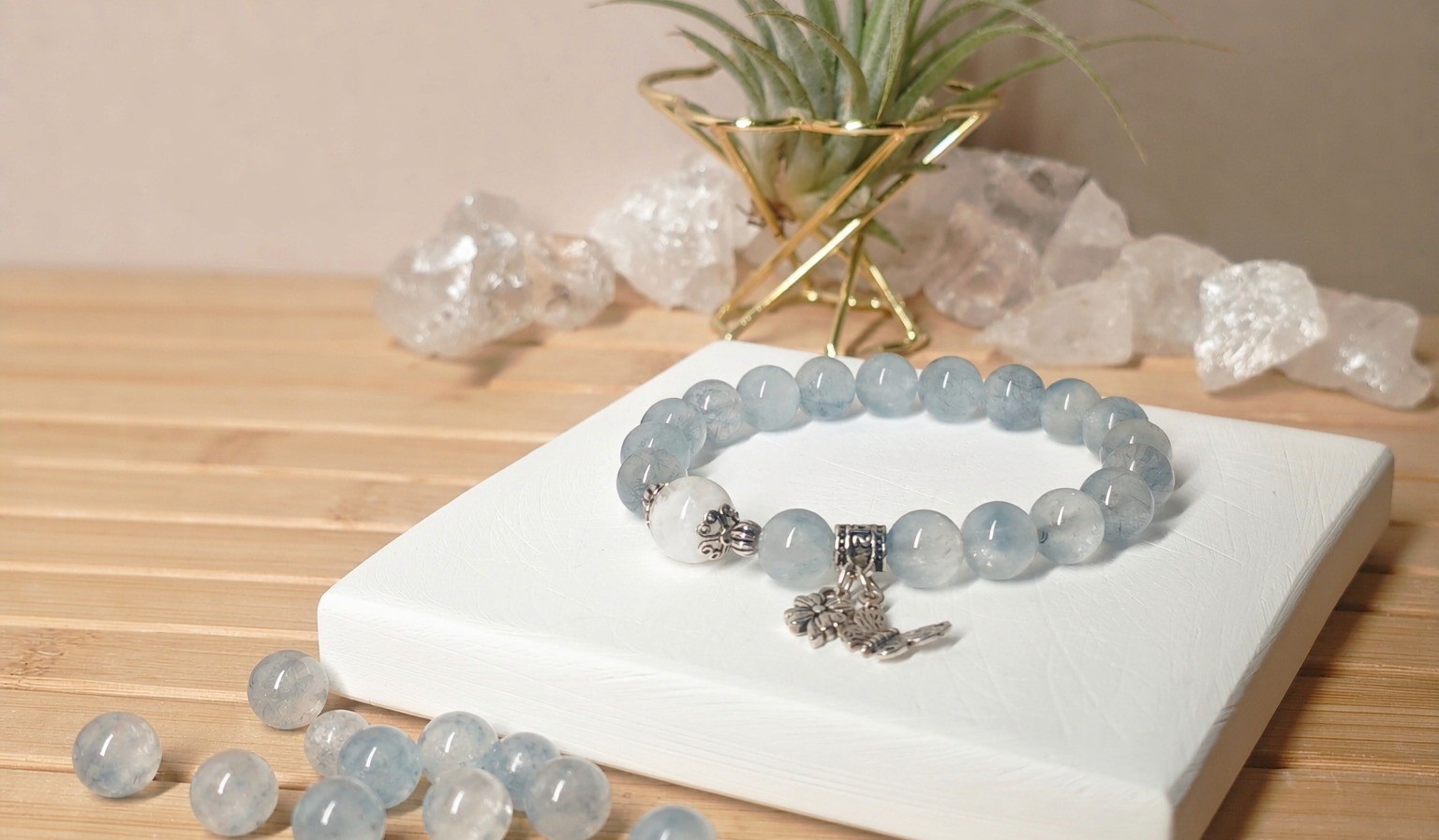
White phantom quartz is the variety most often seen in bracelets: the pale outline reads clearly in a small bead and pairs easily with other stones. It appears in the mix of our blue rutilated quartz success bracelet, where soft white ghost layers sit alongside blue rutile needles.
Chlorite phantom quartz is prized by specimen collectors — a thick enough coating looks like a green landscape suspended inside the crystal. Hematite phantom quartz gives the strongest contrast, a rust-red pyramid in water-clear quartz, and is therefore the easiest type to fake.
Phantom Quartz Meaning in Crystal Tradition
Crystal meanings are cultural and traditional beliefs passed down through crystal tradition, not medical advice. This article is written for education and inspiration only.
In crystal tradition, the phantom quartz meaning centres on the idea of visible growth. Because the stone literally preserves its own earlier form, it is traditionally associated with the layers of a life: what you were, what you are becoming, and the fact that both are held inside the same continuous self.
Common themes that writers and wearers attach to phantom quartz include:
- Progress through stages. Each ghost marks a completed phase rather than a break. The crystal did not stop; it paused, changed, and kept growing.
- Perspective on change. The outline is a reminder that a difficult period becomes one layer among many.
- Patience. Quartz builds over enormous spans of time. Many wearers describe phantom quartz as a stone for long projects and slow goals.
- Integration of the past. The earlier form is not erased; it is incorporated and still visible.
- Clarity about direction. The ghost points the same way as the crystal, which readers of symbolism take as a sign of continued direction.
These associations come from modern crystal writing and earlier folk traditions, not from laboratory research. Read them as a personal framework for intention rather than a description of physical properties. If you are working out which stone suits your own practice, our guide to what crystals are best for you walks through a simple way to decide.
What Many Wearers Describe
Crystal meanings are cultural and traditional beliefs passed down through crystal tradition, not medical advice.
With that caveat in place, here is how people most often describe wearing it:
- A marker stone for starting a new chapter — a new role, a move, a business — because the ghost reads as “the previous version of me.”
- A focus aid during long work, kept on the desk through extended projects.
- A journaling prompt, using the visible layers as a cue to write about what changed in the past year.
- A stacking stone, combined with clear quartz for a light, layered look.
These are descriptions of how people choose to use the stone, not claims about physical effects.
Phantom Quartz vs Rutilated Quartz: What Is the Difference?
These two are constantly confused, because both are included quartz and both are sold as beads. The inclusion structure is completely different.
| Feature | Phantom quartz | Rutilated quartz |
|---|---|---|
| Inclusion form | Thin coating on an earlier crystal face | Loose needle-like rutile crystals |
| Visual pattern | Geometric outline, often pyramid-shaped | Random or radiating threads |
| Inclusion mineral | Clay, chlorite, hematite, iron film | Rutile (titanium dioxide) |
| Number of layers | Can stack in concentric layers | One generation of needles |
| Common colours | White, green, red, smoky | Golden, silver, blue-black |
Put simply: a phantom is a shape; rutile is threads. If you can trace a complete miniature crystal outline, you are looking at a phantom. If you see hair-like strands running through the stone with no outline, you are looking at rutilated quartz.
Our rutilated quartz bracelet collection shows the needle variety in full, and the golden rutilated quartz & citrine bracelet is the clearest example of golden rutile threads in a finished piece.
How to Tell If Phantom Quartz Is Real
Genuine phantoms are common enough that faking them is not especially profitable, but processed and mislabelled material does circulate. Work through these checks:
- Confirm the outline is inside the stone. A real phantom sits below the surface. If the pattern catches your fingernail, it is painted or printed.
- Look for parallax. Rotate the stone; a true internal phantom shifts against the surface facets, a printed pattern does not.
- Check for sharp geometry. Natural phantoms trace the crystal’s own faces, so the ghost is angular and aligned — not a soft blob.
- Use a loupe. At 10x you should see a thin film of coating, sometimes with tiny bubbles or a dusty texture.
- Watch for dye. Brightly coloured ghosts with colour pooled along fractures usually mean dyed quartz.
- Be suspicious of uniformity. Natural phantoms vary bead to bead; identical ghosts in every bead suggest a manufactured pattern.
- Ask about origin. Reputable sellers can name the deposit or at least the country.
How to Choose a Phantom Quartz Bracelet
Once authenticity is settled, the phantom quartz meaning matters less than four practical points:
- Visibility of the ghost. Outlines near the surface show best; deeply buried phantoms can all but disappear in a small bead.
- Body colour. Clear to slightly milky hosts make the outline easiest to read; heavily included hosts swallow it.
- Bead size and finish. Larger beads give the phantom room, and a high polish removes surface haze that competes with it.
- Construction. Check the elastic, knot security and the finish around the drill holes, as with any quartz bracelet.
If you want a quieter, more uniform look, pair phantom beads with a plain clarity crystal bracelet. For a cooler palette, the aquamarine & kyanite bracelet sits well alongside pale white phantoms. And if you are buying for someone else, a bracelet jewellery case keeps the strand from tangling in a drawer.
For more on reading a stone before you buy, see Is Aquamarine a Gemstone or Crystal? and Aquamarine: A Detailed Introduction — both use the same visual checks described above.
How to Care for Phantom Quartz
Quartz is a Mohs 7, hard enough for daily wear, but the coating that creates the phantom is not the same material as the host, so a little care goes a long way.
- Cleaning: room-temperature water, a drop of mild soap and a soft cloth or brush. Rinse and dry thoroughly.
- Avoid heat shock: never move quartz from hot water to cold. Thermal shock can open fractures along a phantom plane.
- Skip harsh chemicals: bleach and acetone dull the polish and, in fractured stones, can affect the coating.
- Ultrasonic cleaners: usually safe on clean quartz, risky on any piece with internal fractures.
- Store separately: quartz scratches softer stones and is scratched by harder ones such as sapphire.
For the fuller ritual and non-ritual routines, including moonlight and dry-salt methods, read How to Cleanse and Recharge a Crystal Bracelet in Detail.
Where Phantom Quartz Fits in a Stack
Phantom quartz is a natural bridge stone: its pale layered look softens the jump between a strongly coloured piece and a plain clear one. Three combinations that work — white phantom with blue rutile, both included quartz with contrasting inclusion styles; white phantom with smoky quartz, where the dark host makes the pale ghost pop; and phantom with aquamarine for a light-on-light stack. Lay pieces flat in daylight and judge them from arm’s length, not close up.
Frequently Asked Questions
What is phantom quartz?
Phantom quartz is quartz that contains a visible internal outline of an earlier stage of its own growth. The outline is a thin coating of clay, chlorite, iron oxide or another mineral that settled on the crystal faces during a pause in growth, then was sealed inside as the crystal continued to grow.
How does phantom quartz form?
Formation takes four steps: crystal growth stops, a thin mineral coating settles on the exposed faces, growth resumes over the coating, and the buried outline remains visible inside. Repeated cycles produce several concentric phantoms.
Is phantom quartz rare?
Phantom quartz is not rare in absolute terms, but pieces with a sharply defined, well-centred and attractive ghost are far less common than ordinary clear quartz. Specimens with multiple stacked phantoms command a premium.
What is the phantom quartz meaning?
In crystal tradition, the phantom quartz meaning is tied to growth through stages: earlier versions of yourself remain visible inside who you are now. It is traditionally associated with patience, long-term projects and marking a new chapter.
How can I tell if phantom quartz is real?
Confirm the phantom is inside the stone, not painted on the surface. Rotate it to check for parallax, look for sharp angular geometry aligned with the crystal faces, and use a 10x loupe to find the thin coating film rather than a printed pattern.
Is phantom quartz the same as rutilated quartz?
No. A phantom is a coating that traces an earlier crystal outline; rutilated quartz contains loose needle-like rutile crystals. Both are included quartz, but the inclusion structure and appearance are different.
Can phantom quartz go in water?
Brief rinses in room-temperature water are fine for most quartz. Avoid hot water, sudden temperature changes, and long soaking in salt water, which can work into drill holes and weaken elastic.
Final Thoughts
Phantom quartz rewards slowing down. Most stones ask you to look at their surface; this one asks you to look through it. Once you know what you are seeing — a recorded pause in a crystal’s growth — the ghost outline stops being a curiosity and becomes the point of the stone.
For a first piece, prioritise the visibility of the outline over size: a small bead with a crisp ghost beats a large bead where the phantom barely registers. And whichever variety you choose, keep the phantom quartz meaning personal — the layers in the stone are simply a good prompt for thinking about your own.