
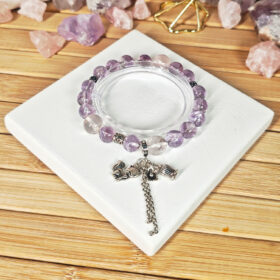
 Amethyst Bracelets
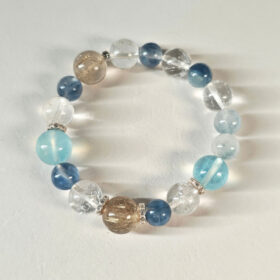 Aquamarine Bracelets
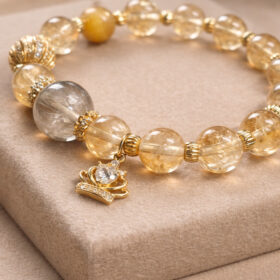 Citrine Bracelets
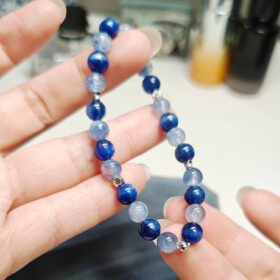 Kyanite Bracelets
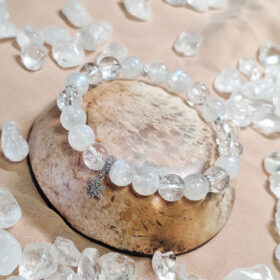 Moonstone Bracelets
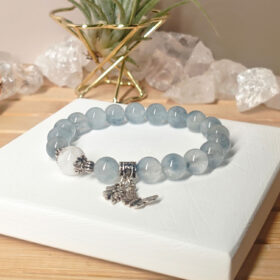 Rutilated Quartz Bracelets
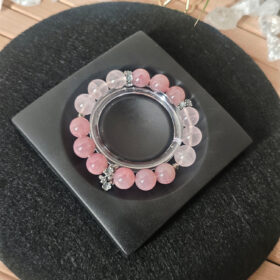 Rose Quartz Bracelets
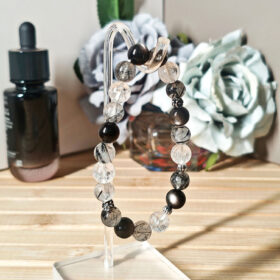 Silver Obsidian Bracelets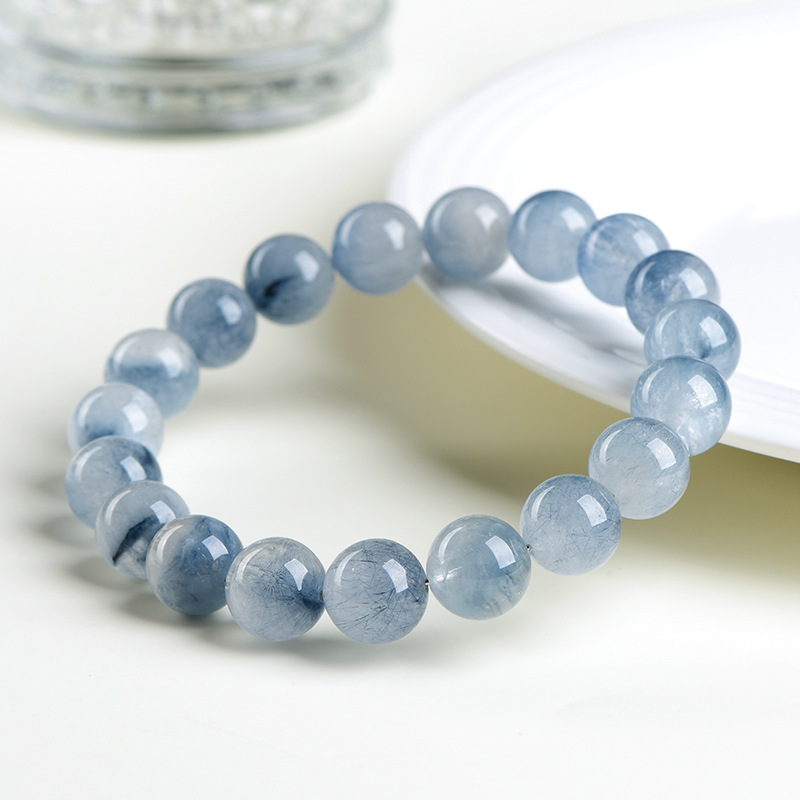
Clear quartz with blue threads suspended inside it looks almost unreal — as if someone had caught light mid-fall and sealed it in stone. That stone is blue rutilated quartz, a variety of quartz shot through with fine blue or blue-grey needles. It is quieter than the golden variety most people know, and in crystal tradition it carries a very different message: not “go faster,” but “get clear, then go.”
This guide covers what blue rutilated quartz actually is (including why the blue threads usually aren’t rutile at all), the meaning and symbolism behind it, how people wear it, and how to tell a genuine piece from a dyed one.
What Is Blue Rutilated Quartz?
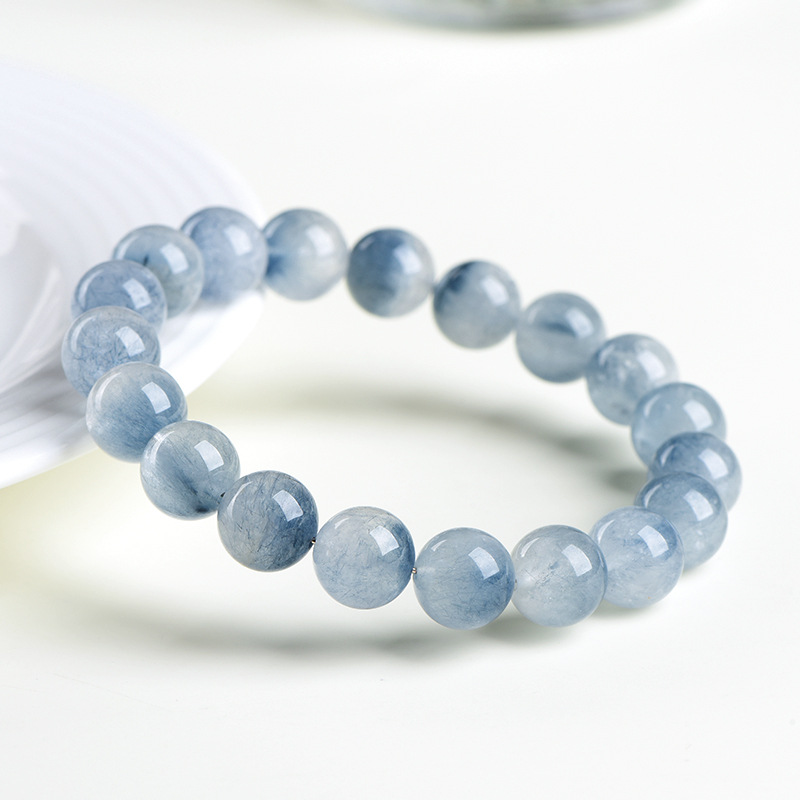
Blue rutilated quartz is quartz — silicon dioxide, Mohs hardness 7 — that contains needle-like or fibrous inclusions in shades of blue, steel blue, and blue-grey. The host crystal is transparent to translucent; the threads sit inside it at different depths, which is what gives good material its sense of dimension.
The inclusions are what make each piece unrepeatable. Some stones hold a few fine strands drifting across clear quartz. Others are dense enough to read as a soft blue haze. Both are the same material; the difference is how much blue mineral got trapped in the silica as the crystal grew.
Why the “rutile” in the name is a little misleading
Here is the part most crystal guides skip. True rutile is titanium dioxide, and it is typically golden, silver, copper-red, or black. Genuinely blue rutile is extremely rare.
So what is making the blue? Usually one of these:
- Dumortierite — a fibrous aluminium borosilicate, the most common cause of blue in quartz
- Indicolite (blue tourmaline) — slender tourmaline needles inside the host
- Kyanite or amphibole-group fibres — blue-bladed or fibrous minerals caught during growth
- Light scattering — in some material, nanoscale inclusions scatter short wavelengths the same way the atmosphere does, producing blue without a strongly coloured mineral at all
A seller’s honest description would often be “blue inclusion quartz” or “blue needle quartz.” The trade name blue rutilated quartz stuck because it is descriptive and customers already know the word rutilated. Neither name is wrong — just be aware the blue threads and the gold threads in quartz are usually different minerals doing different things.
Blue needle quartz, blue hair quartz, and other names
Depending on where you shop, the same stone appears as:
- Blue needle quartz — the most technically accurate description
- Blue hair quartz or blue rabbit hair quartz — common in Asian markets, where fine silky inclusions are described as “rabbit hair”
- Blue sagenitic quartz — used by collectors for branching, star-like or mesh-like inclusion patterns
If you are comparing listings, check the inclusion photo rather than the name. The names overlap freely.
Where blue rutilated quartz comes from
Gem-quality blue quartz hosted material is reported from Brazil (Bahia), Madagascar, and Mozambique, among other localities. Supply is limited compared with common clear or amethyst quartz, which is why clean, well-threaded beads cost more than you might expect. Most cutting and bead production is done in Asia regardless of mine location, so “ships from” tells you nothing about origin.
If you want a specimen-level answer rather than a jewellery-buying one, mindat.org and GIA.edu both maintain reliable mineral references worth checking before a high-value purchase.
To see how this stone reads when it is cut into beads, browse HEYDUCK’s rutilated quartz bracelets — the needle density varies noticeably bead to bead.
Blue Rutilated Quartz Meaning and Symbolism
In modern crystal tradition, blue rutilated quartz is associated with clarity, calm communication, focus, intuition, and composed decision-making. Because rutile inclusions are read as directional — threads pointing somewhere — the stone is often described as giving scattered thoughts a direction to travel in.
The colour adds the second half of the meaning. Blue has long been tied to throat and third-eye themes: speaking, listening, and seeing clearly before you act.
A useful way to hold it: if golden rutilated quartz is the stone of movement, blue rutilated quartz is the stone of direction. It is the pause before the sentence, not the sentence itself.
Throat chakra: saying what you mean
Many wearers connect blue rutilated quartz with the throat chakra, the energy centre linked to expression and being heard. Practically, people reach for it before conversations where the words matter: a difficult talk, a pitch, a review, a boundary that needs stating plainly.
Third eye: seeing it before you say it
The second association is the third eye chakra, tied to intuition and perspective. The pairing is what makes this stone feel balanced — insight and expression supporting each other, rather than one outrunning the other. That is why it suits people who think well but second-guess themselves out loud.
Benefits of Blue Rutilated Quartz
A note before the list: crystal meanings are cultural and traditional beliefs, not medical advice. Nothing here is a treatment, and none of it replaces professional care.
With that said, here is what blue rutilated quartz is traditionally valued for.
- Clearer communication
The most consistent theme you’ll find. Wearers describe it as a prompt to finish the thought before speaking, and to say the plain version rather than the hedged one.
- Composed decision-making
Blue-threaded quartz is often chosen for decisions made under time pressure. The traditional reading is that it slows the panic half a notch so the judgement half can work.
- Focus during long stretches of thinking
Writers, students, analysts, and anyone doing deep work keep it nearby as a cue to stay on one thing at a time.
- Cutting through mental noise
Where clear quartz is often used to amplify, blue rutilated quartz is used to sort — separating the signal from the churn when too many tabs are open in your head.
- Confidence in speaking up
Meetings, presentations, interviews, hard conversations. This is the most common reason people buy it, and it pairs naturally with the throat-chakra association above.
- Intuition and reflection
Used in meditation and journalling for its third-eye association — less about prediction, more about noticing what you already know.
- A steady daily reminder
Perhaps the most honest benefit. A bracelet you see all day is a repeated prompt to act the way you said you would. The stone is the reminder; the work is still yours.
Blue Rutilated Quartz vs. Similar Blue Stones
Blue stones get confused with each other constantly. This table is the fastest way to sort them out.
Stone | What you see | Why it’s blue | Traditional themes | Best for |
Blue rutilated quartz | Clear-to-translucent quartz with fine blue needles | Dumortierite, tourmaline, or amphibole fibres; sometimes light scattering | Clear expression, composed decisions, focus | Everyday wear, work, speaking |
Blue kyanite | Layered bladed crystals, often with visible striations | Natural body colour of the mineral itself | Alignment, blunt honesty, cutting through confusion | Meditation, grid work |
Aquamarine | Transparent blue-to-blue-green gem, no threads | Trace iron in beryl (a different mineral family entirely) | Courage, calm, clear speech | Fine jewellery, heirloom pieces |
Golden rutilated quartz | Clear quartz with gold metallic needles | Actual rutile (titanium dioxide) | Momentum, abundance, confidence | Goal-pushing, new ventures |
Dumortierite quartz | Often milky blue, dense enough to look semi-opaque | Heavy dumortierite fibre concentration | Patience, order, disciplined thinking | Study, long projects |
The short version: if you can see distinct threads inside a mostly clear stone, you are looking at blue rutilated quartz or blue needle quartz. If the entire stone is blue with no fibre structure, it’s more likely aquamarine, kyanite, or dumortierite-rich quartz. And if the threads are gold, you are in golden rutilated quartz territory — a different stone with a different temperament.
Not sure whether you want a threaded stone or a clear blue gem? Reading up on aquamarine is the natural next comparison, since it’s the blue stone most people are already familiar with.
How to Wear a Blue Rutilated Quartz Bracelet
A bracelet is the most practical form for this stone, because its themes are about how you move through an ordinary day — not how it looks on a shelf.
Which wrist? In crystal practice the left hand is the receiving side and the right hand the projecting side, so most people wear blue rutilated quartz on the left to take the quality in. Others switch to the right for situations that call for output — presenting, negotiating, teaching. There is no rule here. Wear it where the meaning makes sense to you.
When it helps most:
- Workdays with back-to-back meetings
- Before a presentation, pitch, or interview
- Writing, studying, or any long thinking work
- Conversations you have been putting off
- Meditation and journalling
What to stack it with:
- White phantom quartz — clears mental clutter, steadies emotion
- Clear quartz — amplifies whatever it sits beside
- Aquamarine — doubles down on calm, clear speech
- Moonstone — softens the edges on high-pressure days
For a ready-made combination, the aquamarine kyanite bracelet pairs naturally with blue-threaded styles for a cool, layered look.
Fit matters more than most people expect. Measure at the narrowest point of your wrist and add 1–2 cm for comfort — a bracelet that slides around becomes a distraction instead of a reminder.
How to Tell If Blue Rutilated Quartz Is Real
Blue is one of the most commonly faked colours in quartz, so this is worth ten minutes of your attention before buying.
Signs the material is genuine:
- Threads follow irregular, natural directions — they do not repeat or line up like printing
- Colour varies in intensity across the stone
- Under light, needles sit at different depths, giving real dimension
- Clear quartz areas remain visibly clear
- There may be small natural features: veils, tiny fractures, mineral dots
Signs you should walk away:
- The blue is vivid, uniform, and identical bead to bead
- Colour concentrates along cracks, while unfractured areas stay pale — the signature of quench-crackle dyeing
- A glassy body with round bubbles — this is glass, not quartz
- Blue that seems to sit on the surface rather than inside the stone
- No inclusion structure visible under magnification at all
Three checks you can do at home:
- Magnify it. A 10× loupe resolves fine threads that photographs hide. Real inclusions have structure; dye has none.
- Transmit light. Hold a torch behind the bead. Natural needles show depth; dye tends to look flat and concentrated.
- The cotton swab test. Acetone or nail-polish remover on the drill hole or an unpolished edge — if blue comes off on the swab, it’s dyed.
Quartz sits at 7 on the Mohs scale, so it scratches glass. Don’t test that on finished jewellery — you risk both the piece and your certainty.
One more note: some natural blue quartz contains crocidolite fibres. If you don’t know what produced the blue, never make a gem elixir with the stone — keep it beside the water, not in it. HEYDUCK only sells natural, untreated crystal — no glass, no synthetics, no dye — and says so on every product page.
How to Cleanse and Care for Blue Rutilated Quartz
Cleanse (traditional): moonlight overnight, resting on a clear quartz cluster or selenite plate, or sound. All three are gentle and none risk the stone.
Clean (practical): a soft dry cloth. That’s genuinely all it needs.
Avoid:
- Soaking in water — the quartz is fine but the elastic cord is not
- Perfume, hairspray, and cleaning chemicals
- Ultrasonic cleaners and steam
- Long periods in direct sun, particularly for dyed or treated material you may not have identified yet
For the full ritual-by-ritual breakdown, see how to cleanse and recharge a crystal bracelet.
Store it separately from harder stones like sapphire and diamond, which can scratch quartz, and apart from softer stones quartz can scratch.
Who Is Blue Rutilated Quartz For?
Based on its traditional associations, this stone tends to appeal to:
- People who talk for a living — managers, teachers, consultants, salespeople, creators
- Anyone deciding things under pressure — where keeping a steady head matters more than being loud
- Highly sensitive people who absorb other people’s moods easily
- Writers and deep thinkers looking for a focus anchor
- Anyone working on saying what they actually mean
In modern crystal astrology it’s linked with Gemini, Libra, Aquarius, and Pisces — though these correspondences are a modern tradition, not a rule.
As a gift, it carries a clear message for: a promotion, a new job, a business launch, a graduation, a big presentation, or anyone about to speak up about something that matters.
Blue Rutilated Quartz and White Phantom Quartz: A Career Pairing
Two stones are often better than one when they do different jobs.
Blue rutilated quartz brings the direction: clarity, composed decisions, the nerve to say the thing. White phantom quartz handles the interference: clearing mental clutter, holding focus on the goal, keeping emotion steady.
Together they cover both halves of the same problem — not knowing what you want, and getting knocked off course before you get there. It’s why this pairing shows up in career-focused designs rather than purely decorative ones.
The Blue Rutilated Quartz Career Bracelet is built on exactly this combination: 8–8.8 mm blue rutilated quartz with 10 mm white phantom quartz and oxidised Thai silver accents, strung on durable elastic. Each one is handmade and cleansed before shipping.
For a clearer-leaning alternative, HEYDUCK’s clarity crystal bracelet works along similar lines.
A Last Word
Most blue crystal jewellery asks you to feel something. Blue rutilated quartz asks you to say something.
If what you want is a reminder to think clearly, speak plainly, and keep your head when the pressure is on, this is the stone that does that job — quietly, every day, on your wrist. And if the threads catch the light at the right moment, that’s a bonus.
Explore the Blue Rutilated Quartz Career Bracelet, or browse the full rutilated quartz bracelets collection to compare how different stones carry their threads.
Keeping a collection? A crystal bracelet organizer keeps pieces from scratching each other — worth it once you pass two or three bracelets.
Crystal meanings described in this article are cultural and traditional beliefs. They are not medical claims and are not a substitute for professional medical advice.