
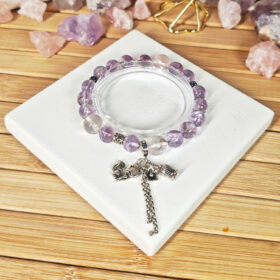
 Amethyst Bracelets
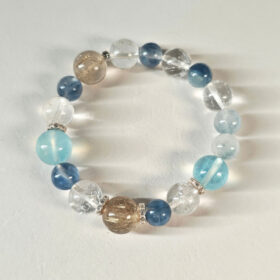 Aquamarine Bracelets
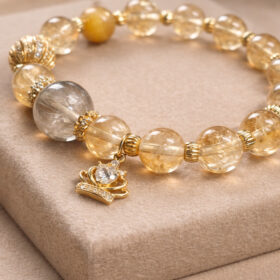 Citrine Bracelets
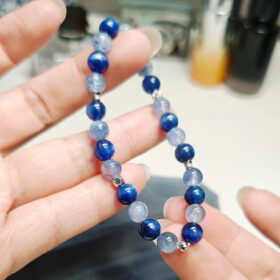 Kyanite Bracelets
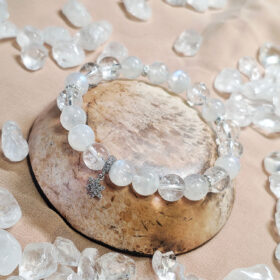 Moonstone Bracelets
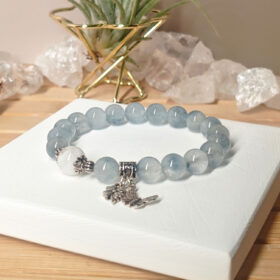 Rutilated Quartz Bracelets
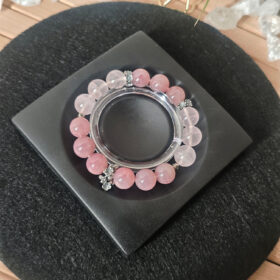 Rose Quartz Bracelets
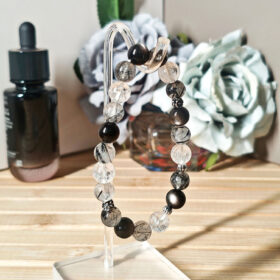 Silver Obsidian Bracelets
Fit First
The bracelet you keep is the one that actually fits.
Crystal Bracelet for Women
A 2026 buyer’s guide: fit, bead size, cord, metal.
How to Choose a Crystal Bracelet for Women
Measure the wrist, pick the bead, check the metal — before you check out.
Shop Crystal BraceletsHow to Choose a Crystal Bracelet for Women
A good crystal bracelet for women is a small object that has to work in three different ways at once: it must fit, it must survive daily wear, and it must look like something you actually want on your wrist in ten years. Most buyers only think about the third one — the photo — and end up with a bracelet that slips off, dulls, or reads as costume jewellery within a month.
A good one answers those three questions on the product page; a poor one hides behind styling. This guide is the checklist we wish more shoppers used before checkout. It covers fit, bead size, stringing, stone pairing, and the quality details that separate a piece you keep from a piece you resell.
Why the Fit Comes Before the Stone
The single most common reason a crystal bracelet ends up unworn is size, not design. A strand that slides past the knuckles gets pushed up the forearm all day; one that leaves a mark comes off after an hour and never goes back on.
Fit should be measured for, not guessed at. Measure the wrist at its narrowest point, just below the wrist bone, with a soft tape and no slack. Then add the allowance that matches how you want the bracelet to sit:
| Wrist measurement | Add this | Result |
|---|---|---|
| 14 cm / 5.5 in | +1.5 cm | Snug, no movement |
| 16 cm / 6.3 in | +2 cm | Close fit, slight movement |
| 18 cm / 7.1 in | +2.5 cm | Relaxed, sits low on the wrist |
Between sizes: elastic, take the smaller one; clasp or slider, take the larger one.
For a deeper breakdown of measuring at home, including how to size as a gift, see our crystal bracelet size guide.
Bead Size Decides the Character of the Bracelet
Bead diameter changes how a crystal bracelet for women reads far more than colour does. The same stone at 4 mm looks like a delicate second skin; at 12 mm it looks sculptural. Quartz varieties are catalogued in detail on Mindat, worth a glance if you want to know what a stone actually is before you buy it.
- 4–6 mm — Fine and layer-friendly, good for small wrists and for stacking.
- 7–8 mm — The everyday middle ground, and the range most women settle on. Visible stones, still comfortable under a sleeve.
- 9–10 mm — A statement without being heavy; inclusions and colour become visible.
- 12 mm and above — Bold, single-strand, worn alone. On a wrist under 15 cm this can feel oversized and top-heavy.
One practical rule: on a 15 cm wrist, anything above 10 mm starts to look like it is wearing you. Balance bead size against the wrist, not the product photo.
How Many Beads Actually Fit
Bead count is a useful sanity check online: it shows whether the strand was sized for the bead.
A 17 cm strand holds roughly:
| Bead size | Approximate bead count |
|---|---|
| 4 mm | 40–43 |
| 8 mm | 21–23 |
| 10 mm | 17–18 |
| 12 mm | 14–15 |
If a listing claims a 17 cm bracelet with 12 mm beads and 24 beads, the maths does not work — the strand would be closer to 29 cm. Count before you buy.
Stringing: Elastic, Clasp or Slider
Elastic (stretch) is the most common construction for crystal bracelets and the easiest to wear. Quality depends almost entirely on the cord: doubled or quadrupled clear elastic inside a knotted channel is standard; a single strand with a visible knot at the surface is a warning sign. Expect restringing every one to three years of daily wear — normal, not a defect.
Clasp and chain give a crystal bracelet for women a more precise fit and a more formal look. Lobster clasps in sterling silver or gold vermeil age better than base-metal spring rings, which lose tension. The trade-off: a clasp needs slack to fasten, so it moves more.
Adjustable slider suits gifting, but the slider is the weak point — check it holds under a light pull.
Match the closure to how the bracelet will be worn.
Which Stones Pair Well Together
A bracelet with two or three stones reads as intentional; five or six usually reads as busy. The rule that works most often is one anchoring stone plus one or two supporting stones, with the anchor carrying the size and the supporting stones adding contrast.
Three pairings that hold up visually and symbolically:
- Aquamarine + blue kyanite + moonstone — Cool, pale, and legible. In crystal tradition aquamarine is associated with calm and clear expression, kyanite with alignment, and moonstone with intuition. Together they read as a quiet, professional piece. See the aquamarine bracelet guide for the symbolic detail on each stone.
- Golden rutilated quartz + citrine — Warm and luminous. Rutilated quartz is traditionally associated with drive and direction, citrine with abundance and clarity of purpose. Together they are the most photographed warm-toned pairing in the category; our golden rutilated quartz and citrine guide covers the symbolism in full.
- Blue rutilated quartz + clear quartz — Cooler and more restrained. Blue rutilated quartz is associated in crystal tradition with focus and steady progress; see the blue rutilated quartz meaning.
For a single-stone bracelet, clear quartz, amethyst, and rose quartz remain the three easiest entry points. If you are still deciding which stone suits you, our guide to choosing the right crystal walks through the decision by intention rather than by colour.
Crystal meanings referenced in this guide are cultural and traditional beliefs, not medical or clinical advice. A bracelet is a piece of jewellery.
What the Stones Should Actually Look Like
Natural stone varies, and that variation is the point. What you want is consistent variation — every bead slightly different, but the strand clearly one family of stones.
Signs the strand is natural:
- Inclusions, veils, and colour zones sit at different depths in different beads.
- Beads are not perfectly identical in size (hand-sorted strands are usually within ±0.5 mm).
- Small surface irregularities you can feel with a fingernail, and a strand with real weight that feels cool for a moment.
Signs to slow down:
- Every bead looks like the same photograph, printed 20 times.
- Uniform size, colour and shine across every bead, at a suspiciously low price.
For a full checklist including the weight test and the temperature test, see see how to spot a real crystal bracelet. For the gemmological side — hardness, clarity grading and identification — the GIA Gem Encyclopedia is the reference most jewellers use.
Metal Hardware: The Part Nobody Checks
The stones get the attention; the spacers and charms decide whether the bracelet still looks good in year two. The hardware decides how long it lasts. Ask two questions:
- What is the metal? Sterling silver (S925) and gold-filled or 14k vermeil hold up. Base metal with gold plating will discolour at the contact points within a season, especially on a wrist that sees water, lotion, and hand sanitiser.
- How is the charm attached? A soldered jump ring or a closed bail survives daily wear. An open ring that was simply pinched shut will eventually open.
If a listing names the stone in detail but not the metal, that shows where the cost went.
Size Charts, Not Guesswork
A properly sized bracelet comes with a published chart — centimetre ranges, not just S/M/L. Compare your wrist to the chart, then check the bead diameter — heavy beads need more allowance because they do not flex around the wrist bone.
Buying as a gift without a wrist measurement? Take the middle size, in an elastic or adjustable construction. Estimating from body build rarely works — wrist size varies independently of frame.
For a fixed size, choose an adjustable or a mid-range strand.
How It Should Be Worn
Decide which of these three habits is yours before you buy a crystal bracelet for women:
- Alone, single strand. The bracelet is the focal point. Go larger in bead size (8–10 mm) and keep the metal minimal.
- Layered with a watch or a second bracelet. Go smaller (4–6 mm) and keep the palette in one temperature — all cool, or all warm. Mixing cool aquamarine with warm citrine in a stack usually looks accidental rather than designed.
- Alternating wrists or days. Two bracelets in different palettes covers more outfits than one very expensive bracelet in one palette.
Whichever you choose, wear the charm facing the same direction each time — it keeps the strand from twisting.
Care That Actually Extends Life
Longevity is mostly about keeping it dry, not cleaning it more. Three habits matter more than any product:
- Keep it dry. Take the bracelet off before showering, swimming, or washing dishes. Water degrades elastic and dulls silver.
- Last on, first off. Lotion, perfume, and sunscreen should be dry before the bracelet goes on.
- Rest it flat. Store flat, in the box — hanging a heavy strand stretches the cord.
For the fuller routine, including how to clean between beads and how to recharge stones traditionally, see how to cleanse and recharge a crystal bracelet.
Where Crystal Bracelets Sit in a Jewellery Wardrobe
The right crystal bracelet for women is not the most expensive one; it is the piece you reach for without thinking, survives a commute, and still means something when you look down at it.
That is why, with a crystal bracelet for women, the practical details matter more than in a piece worn twice a year.
If you are building a collection, start with a neutral palette and add one warm strand later. Browse the full range of crystal bracelets to see how different palettes sit against each other, or look at the rutilated quartz bracelets if you want the most visually distinct option in the category.
Two pieces that sit at the two ends of that palette decision:
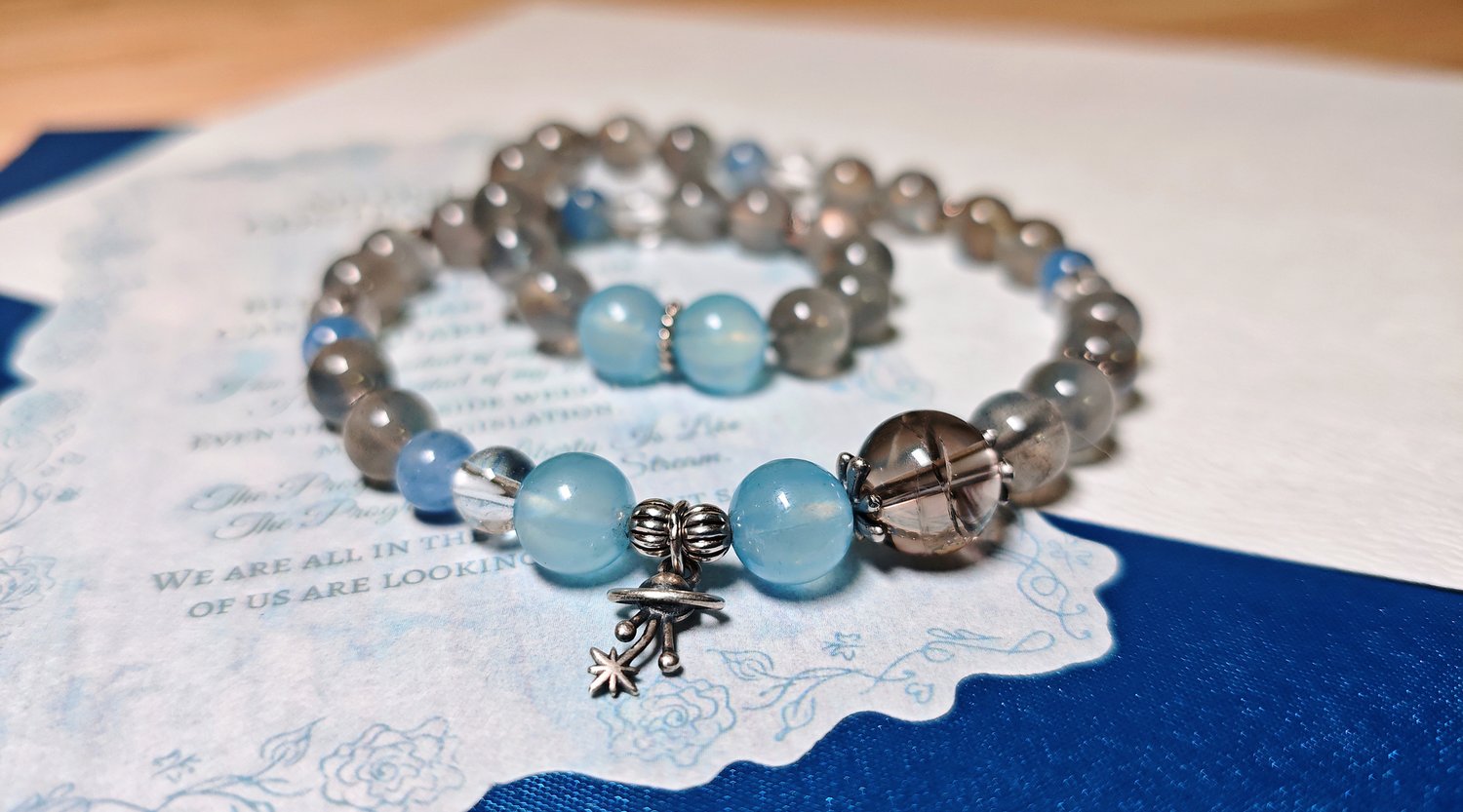
- Career Orbit Crystal Bracelet — a double-wrap in aquamarine, blue kyanite, gray moonstone, and ice black-gold quartz, finished with a small sterling silver planet. Cool-toned, composed, and the closest thing to a neutral statement piece in the range. View the bracelet.
- First Light Crystal Bracelet — golden rutilated quartz with ice citrine and a gold-tone crown, in a warm honey palette. The better choice if your wardrobe runs warm or you already own cool-toned silver pieces. View the bracelet.
For a deeper symbolic option, the blue rutilated quartz career bracelet pairs rutilated quartz with white phantom quartz, and the amethyst lucky clover family covers the classic purple palette. If you already own two or three bracelets, a bracelet jewellery case keeps strands from tangling and stops the elastic from being stretched in a drawer.
A Five-Minute Pre-Purchase Check
Before you check out, confirm five things about the crystal bracelet for women you are about to buy:
- The seller lists actual centimetre ranges for sizing, not just S/M/L.
- The bead diameter is stated in millimetres.
- The metal is named (S925, gold-filled, vermeil) rather than “gold colour”.
- The cord type is described — elastic, clasp, or slider — and how it is finished.
- The return window is long enough to try it on and send it back.
If all five are answered on the product page, the seller has thought about wear, not just photography.
Frequently Asked Questions
What size crystal bracelet should I buy for a woman?
Measure the wrist at its narrowest point and add 1.5–2.5 cm depending on how loose you want it to sit. Most women fall between 15.5 and 18 cm in finished bracelet length. If the bracelet is elastic, size down when between sizes; if it has a clasp, size up.
Is a stretch crystal bracelet good quality?
A stretch bracelet can be excellent quality — the construction matters more than the closure type. Look for doubled or quadrupled elastic cord, a knot that sits inside a bead rather than on the surface, and a seller who states that restringing is expected every one to three years of daily wear.
What bead size is best for a small wrist?
On a wrist under 15 cm, 6–8 mm beads read as jewellery rather than as a heavy strand. Beads above 10 mm can overwhelm a small wrist and make the bracelet top-heavy, which causes it to rotate. If you love a large bead, wear it alone rather than in a stack.
Can I wear a crystal bracelet every day?
Yes, with two adjustments: take it off for showers, swimming, and washing dishes, and put it on after lotion and perfume have dried. Daily wear will eventually relax an elastic cord, which is normal. A clasp or slider bracelet lasts longer between services because there is no cord under constant tension.
How do I know the stones are real before buying?
Ask for bead diameter, stone origin where available, and close-up photos of individual beads rather than one styled shot. Natural stone shows inclusions at varying depths, slight size differences, and small surface irregularities. Uniform colour and uniform shine across every bead usually indicates glass or reconstituted material.
What is a good crystal bracelet gift for a woman?
An elastic or adjustable bracelet in the 6–8 mm range is the safest gift, because it needs no exact wrist measurement and suits most wardrobes. Choose a palette that matches what she already wears — cool tones if her jewellery is silver, warm tones if it is gold. Include the size range rather than a single size.
How many stones should a crystal bracelet have?
Two or three stones is the sweet spot for a designed look. One anchoring stone carries the size and colour, and one or two supporting stones add contrast. Strands with five or more stones tend to read as busy and are harder to match to an outfit.
Final Word
The best crystal bracelet for women is not the most expensive one in the category — it is the one whose fit, cord, metal, and bead size were all considered before the photograph was taken. Measure your wrist, decide your bead size, check the hardware, and buy from a seller who answers those questions on the page.
Crystal meanings throughout this guide are drawn from cultural tradition and are not medical advice. If you are choosing a bracelet for a symbolic reason, read it as symbolism — a piece of jewellery with a story you chose.