
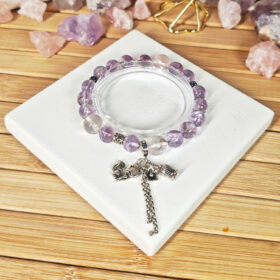
 Amethyst Bracelets
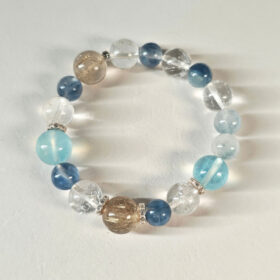 Aquamarine Bracelets
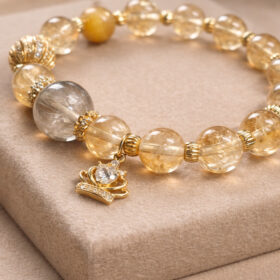 Citrine Bracelets
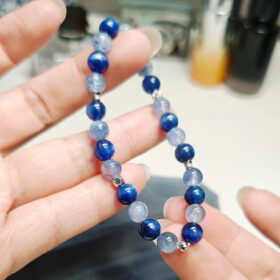 Kyanite Bracelets
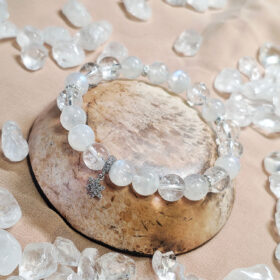 Moonstone Bracelets
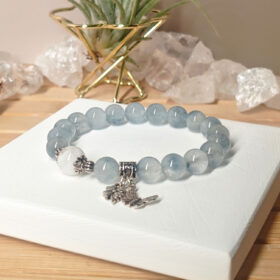 Rutilated Quartz Bracelets
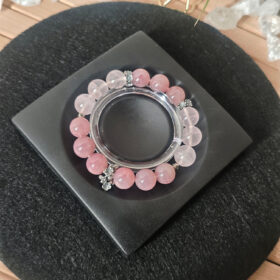 Rose Quartz Bracelets
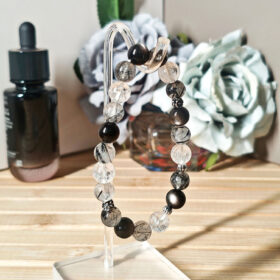 Silver Obsidian Bracelets
Read the Needles
Gold rutile, bead by bead.
Clarity, needle length, bead matching and an honest price. Five minutes of looking tells you most of it.
Golden Rutilated Quartz: What to Look For
Before you buy the strand, read the stones.
Shop Crystal BraceletsA golden rutilated quartz bracelet is one of the few crystal pieces you can judge almost entirely with your eyes — if you know what you are looking at. The gold needles suspended inside each bead are natural rutile crystals, and their density, length and direction tell you more about quality and price than any certificate on the listing page. This guide walks through the checks we use when we examine a strand ourselves, from needle structure to bead matching to the price band a genuine piece should sit in.
If you are still deciding whether rutilated quartz is the right stone for you at all, read this first, then come back — the buying checks below assume you have already chosen the stone.
What a Golden Rutilated Quartz Bracelet Actually Is
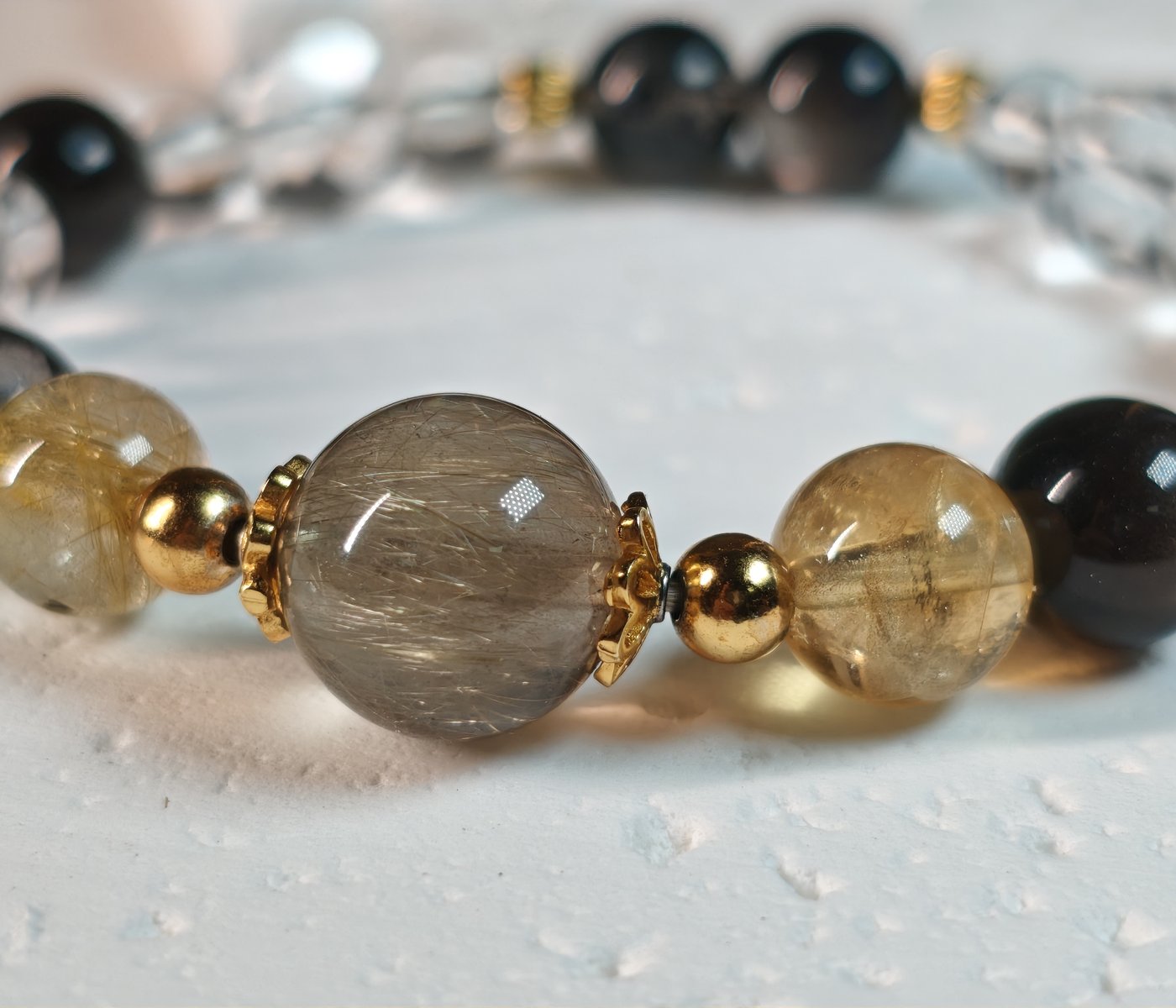
Rutilated quartz is clear or smoky quartz that grew around needles of rutile, a titanium dioxide mineral. The quartz forms first; the rutile grows through it later, threading the host crystal with fine metallic hairs. On a polished bead the needles look like strands of gold suspended in glass, which is why the stone was traded for centuries under the name Venus hair stone.
Two things follow from that geology, and both matter when you shop.
First, every bead is different. Needle direction, density and thickness are random inside the rough, so a bracelet is always a set of mismatched stones. A strand where all twenty beads look identical is a strand worth questioning.
Second, the needles are inside the stone, not on it. Nothing is glued, coated or foiled onto the surface of a genuine bead. Run a fingernail across a bead and you should feel polished quartz, uninterrupted.
Where the Golden Needles Come From
Rutile is a common mineral — it is what gives titanium its ore value — but rutile growing inside gem quartz in long, visible, golden hairs is not common at all. Brazil supplies most of the material on the market, with smaller production from Madagascar and India. Much of what reaches bead form is offcut from faceting rough: pieces too included for a gemstone cut still make beautiful beads, because a bead shows the interior from every angle.
That is also why the best bracelets tend to come from small workshops rather than factories. Someone has to sort rough by eye, cut around fractures, and then pair beads so the strand reads as one object rather than twenty unrelated ones.
The mineral itself is well documented — the GIA gem encyclopedia covers the host quartz, and mindat lists rutile as a distinct species — but no database will tell you whether a specific strand was sorted well. That judgment is visual.
Golden vs Blue vs Black Rutilated Quartz
The colour of the needles comes from trace elements and from how the rutile grew, and the three main varieties behave very differently in a bracelet.
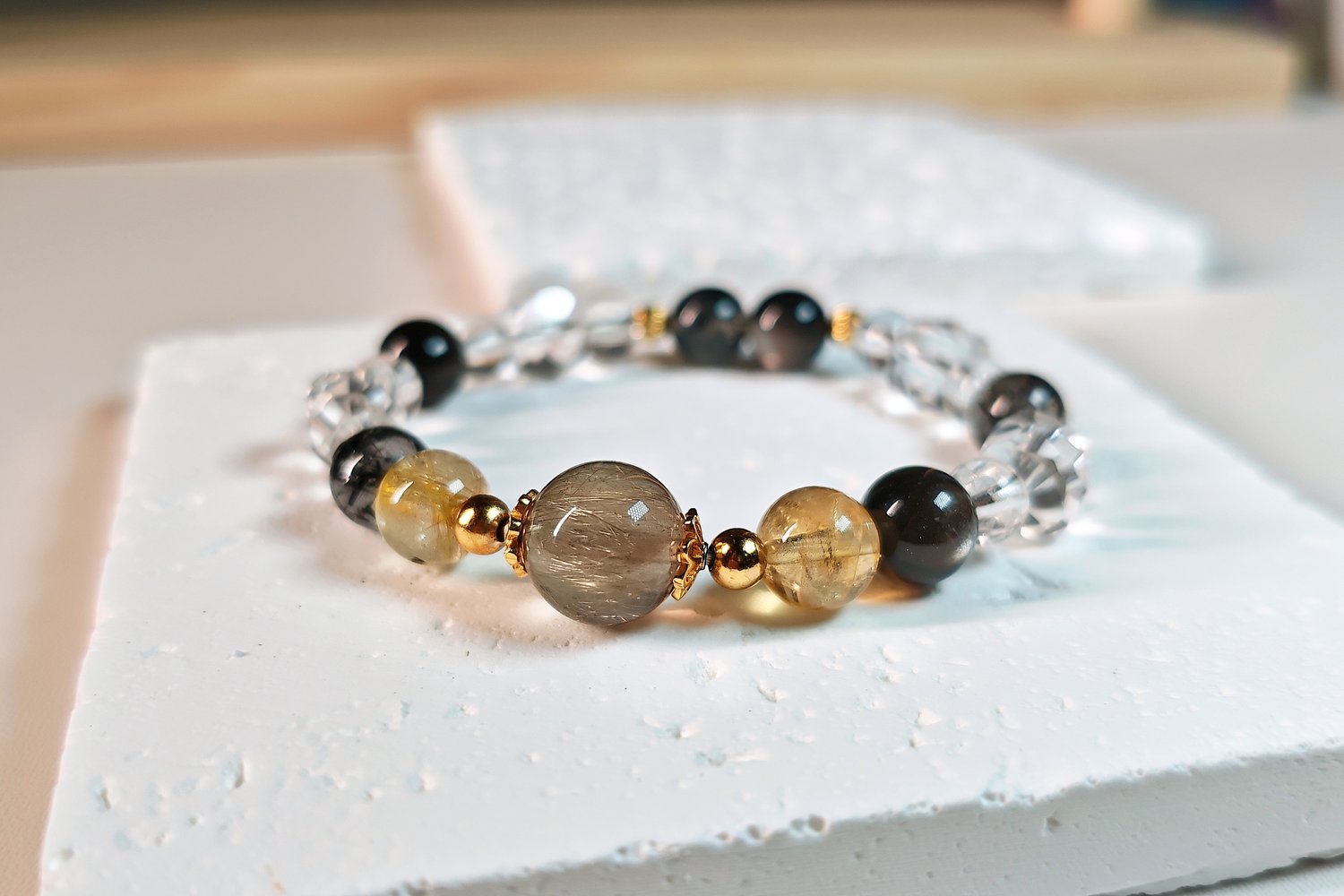
Golden rutilated quartz has warm yellow to champagne needles. It photographs well, flatters warm skin tones, and is usually the most available of the three. Because the palette sits close to citrine, it is often paired with citrine beads, as in the First Light crystal bracelet — a warm strand that reads gold from across a room.
Blue rutilated quartz carries steel-blue to slate needles against a cooler body. It is rarer, quieter, and photographs less dramatically; in person it looks like brushed metal under water. If you want something that does not announce itself, this is the version to look at — our blue rutilated quartz guide covers the stone in detail.
Black rutilated quartz has dense, dark needles, sometimes called tourmalinated when the dark inclusions are tourmaline rather than rutile. It is graphic and high-contrast, best in larger beads where the pattern has room to read.
For a first rutilated piece, gold is the safest choice: the needles stay visible in low light, and the stone works with both yellow and white metal in a stack.
What Separates a Good Bracelet from an Average One
Five factors decide whether a strand looks expensive or looks like a craft-fair leftover. Inclusion research published in GIA’s Gems & Gemology is a useful reminder of how variable natural quartz actually is — the same variability you are judging by eye.
Body clarity. The quartz between the needles should be transparent. Hazy, milky or fractured bodies flatten the gold and make the bracelet look dull. Some veil-like inclusions are natural and acceptable; dense cloudiness is not.
Needle density and length. Sparse, short needles read as dust. Long, distinct hairs that cross the bead diagonally are the desirable look. Density should be enough to be legible at arm’s length, not so heavy that the bead turns opaque.
Needle direction. Needles that run in one clear direction catch light as the wrist moves. Scattered, chaotic needles are still natural, but they read flatter. Neither is a defect — one is simply more photogenic.
Bead matching. Beads should be close in diameter and tone. A 10 mm bead next to a 12 mm bead on the same strand is a sorting failure, not a design choice.
Polish and drilling. Look at the bead holes. Chipped edges around the drill hole mean rough finishing, and rough holes fray the elastic faster than anything else on the bracelet.
Natural Quartz or Imitation: Four Checks
Rutilated quartz is imitated mostly in glass, because glass is cheap and the needle effect is easy to fake. Four checks catch nearly all of it.
Look at where the needles end. In natural quartz, hairs taper and stop inside the stone, often at a fracture or a veil. In glass imitations, fibres usually run to the bead surface and stop dead, in perfectly parallel bundles.
Look for bubbles. Spherical bubbles are a glass signature; natural quartz does not contain round air bubbles. A jeweller’s loupe makes this obvious in seconds.
Check for uniformity. Real rutile is irregular: some needles thick, some thin, some bent, some crossing. Suspiciously even, hair-thin, perfectly spaced fibres are manufactured.
Weigh it. Glass feels light and slightly slippery; quartz has heft and takes a moment to warm. This is a supporting check, not a decisive one — plenty of good sellers ship honest stones, and this test alone will not separate them from a careful faker.
For a full at-home protocol, including the scratch and bead-hole checks, see our guide to spotting a real crystal bracelet.
Seven Things to Check Before You Buy
Working through these in order takes about five minutes with a listing page, and less with the bracelet in hand.
- Photographs in daylight, not on white. Warm gold needles photographed against a white background lose their colour. Ask for an indoor, unedited photo.
- A close-up of a single bead. You are looking for the needle structure described above, not a lifestyle shot.
- The stated bead diameter. Anything between 8 mm and 12 mm is normal for a rutilated bracelet; a listing that never states it is a listing that has not thought about fit.
- The metal content of the spacers. Gold-toned spacers are usually brass or stainless steel with plating. Plating wears; solid gold does not, and the price should say which one you are getting.
- Return terms. Natural stone varies bead to bead. A seller who will not accept a return on a photographic mismatch is telling you something.
- Whether the strand is graded or sorted. “Hand-sorted” is a claim worth a follow-up question: sorted by what, clarity or colour?
- The total weight or bead count. Fewer beads at the same diameter means a smaller wrist size, not a better deal.
What Golden Rutilated Quartz Is Traditionally Associated With
Crystal meanings are cultural and traditional beliefs, not medical advice. Nothing here is a diagnosis, a recommendation or a substitute for professional care.
In crystal tradition, rutilated quartz is read as a stone of direction. The needles are read as threads of intention running through clear thinking, and the stone is traditionally associated with decisiveness, momentum and the ability to see a situation without flinching from it. Many wearers describe reaching for it during transitions — a new role, a move, a decision that has been postponed too long.
Golden rutilated quartz carries the warmer end of that tradition: gold as the colour of recognition and reward, which is why the stone is so often paired with citrine in abundance-focused pieces. Our guide to golden rutilated quartz and citrine goes deeper into why those two are combined.
What the tradition is not is a promise. If you are drawn to the stone, wear it for the reminder it gives you; the work is still yours.
How to Wear It: Fit, Bead Size and Stacking
Fit comes first. A rutilated bracelet should sit against the wrist bone without pressing; roughly one finger’s width of slack is the target for a beaded strand. Measure your wrist with a strip of paper, add 1.0 to 1.5 cm, and match that to the strand’s stated circumference. Our crystal bracelet size guide has the full measuring method, including how to size for a larger forearm.
Bead size changes the character more than the colour does. 8 mm reads delicate and stacks easily; 10 mm is the everyday default; 12 mm and above becomes a statement piece and suits a wider wrist or a unisex look.
For stacking, rutilated quartz pairs best with stones that do not compete. Clear quartz is the cleanest partner — it adds brightness without adding another pattern, which is the logic behind wearing it alongside a clear quartz clarity bracelet. Warm gold also works against a cool blue, which is where blue rutilated quartz earns its place in a two-strand stack.
Keep the metal consistent within a stack. Mixing a gold-toned rutilated strand with silver-toned pieces is fine if the metals are deliberately mixed; half-mixed looks like an accident.
Who it suits. The stone tends to appeal to people who want something warm but not ornate. It is the natural choice for anyone building a first “serious” crystal bracelet — the material is distinctive enough to hold its own and neutral enough to wear daily. It also suits people who dislike the pastel register of rose quartz or the deep violet of amethyst and want a stone with more restraint.
If you are still comparing options across stones, our guide to choosing the right crystal maps the main families by temperament rather than by claim.
Care That Keeps the Gold Bright
Rutilated quartz is durable — quartz sits at 7 on the Mohs scale — but the metal between the beads is the fragile part. Warm water with a drop of mild soap, a soft brush at the drill holes, and a rinse is all the cleaning the stone needs. Skip ultrasonic cleaners and steam: they attack plated spacers and can loosen settings.
Dry the bracelet fully before storing it, and keep it in its own pouch. Quartz will scratch softer stones in a shared jewellery box, and plated spacers dull when they rub against each other.
For the monthly routine — including what to do about dull elastic and how to recharge a bracelet in crystal tradition — see our cleansing and recharging guide. One addition for this stone: avoid long soaks in salt water, which dull gold plating faster than plain water.
What a Fair Price Looks Like
Pricing in rutilated quartz tracks four variables: body clarity, needle quality, bead diameter and metal. As a rough frame, a well-sorted 10 mm strand with clear bodies and long gold needles, finished with plated spacers, sits in the low to mid hundreds of dollars at retail. Solid gold findings and larger beads push the price up sharply, because the metal, not the stone, becomes the cost.
Be sceptical of two extremes. Very cheap strands with large, clean beads are usually glass, reconstructed stone or heavily included quartz photographed against strong light. Very expensive strands should come with a description specific enough to justify the number — bead diameter, bead count, metal content and a return policy.
You can see the current range across our rutilated quartz bracelet collection, and compare it against the wider crystal bracelet catalogue if you are still deciding on a stone.
Frequently Asked Questions
What is a golden rutilated quartz bracelet made of?
Clear or smoky quartz beads containing natural rutile needles, usually strung with metal spacers and finished with an elastic core. The gold colour belongs to the rutile, not to the quartz.
How can I tell if a golden rutilated quartz bracelet is real?
Look at where the needles end: natural hairs taper and stop inside the stone, while glass imitations run in parallel bundles to the surface. Then check for round bubbles, which only appear in glass.
Is golden rutilated quartz the same as citrine?
No. Citrine is quartz coloured yellow by trace iron; golden rutilated quartz is quartz containing gold rutile needles. They are often worn together because the palettes match, but they are different materials.
Does the stone fade in sunlight?
The rutile needles are stable in normal wear. Citrine beads paired with it can lose saturation after prolonged direct sun exposure, so store the bracelet away from a sunny windowsill.
What bead size should I choose for a golden rutilated quartz bracelet?
8 mm for a delicate look or a small wrist, 10 mm as the everyday default, 12 mm and above for a statement piece. Measure your wrist and add 1.0 to 1.5 cm for the strand circumference.
Can I wear it every day, including in water?
Yes, with two exceptions: take it off for swimming pools and hot tubs, where chlorine dulls plating, and avoid long salt-water soaks. Brief contact with fresh water while washing hands is harmless.
Should a rutilated quartz bracelet have identical beads?
No, and it should not. Needle direction and density vary from bead to bead in the rough. What should match is diameter, tone and overall clarity — a strand with wildly mismatched bead sizes was not sorted.
The Takeaway
A golden rutilated quartz bracelet rewards a five-minute inspection. Check the clearance of the quartz body, the length and direction of the needles, the consistency of the beads, and the honesty of the listing about metal and size. Get those four right and the stone will look better in person than in the photograph, which is the opposite of how most crystal purchases go.